
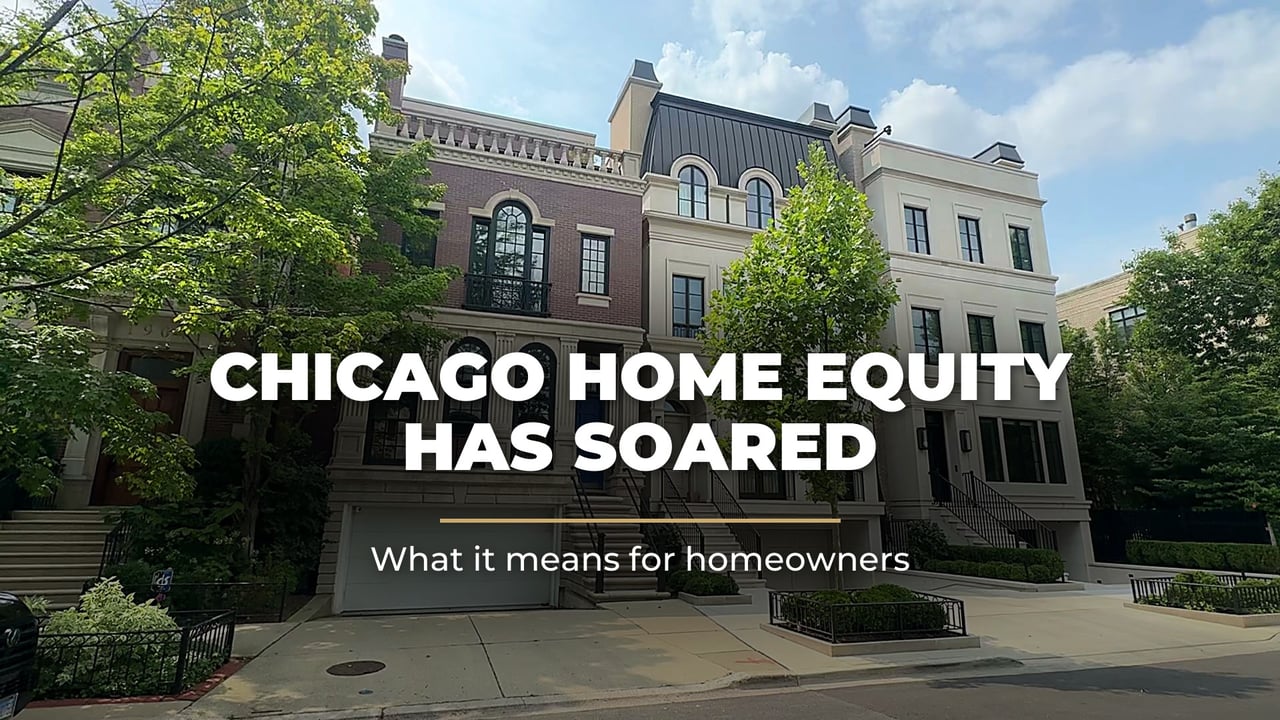
Have you checked how much equity you have in your Chicago home lately? You might be surprised. According to the ICE Mortgage Monitor, 35,432 Chicago metro homeowners with mortgages now have at least $1 million in home equity, compared with just 7,312 in 2019. That is nearly five times as many homeowners in just seven years. And you do not need a million dollars in equity for this to be good news. Whether you are thinking about selling, downsizing, relocating or simply curious about what your home is worth today, the equity you have built could give you more options than you realize.
I have been helping people buy and sell homes in Chicago for more than 24 years, and this is a conversation I have with long-time homeowners all the time. They know their home has appreciated, sometimes substantially. What they are less certain about is what that equity can do for their next move.
Let me show you what the numbers actually say, why Chicago home equity has grown so much, and three options worth considering.
Chicago homeowners have built substantially more equity since 2019. According to the ICE Mortgage Monitor, as reported by Crain's Chicago Business in November 2026, the number of Chicago metro mortgage holders with at least $500,000, $750,000 or $1 million in equity has increased roughly four to five times.
Here is how the numbers compare:
Equity level | Owners in 2019 | Owners in 2026 |
|---|---|---|
$500,000 or more | 40,758 | 189,301 |
$750,000 or more | 14,712 | 74,148 |
$1,000,000 or more | 7,312 | 35,432 |
Source: ICE Mortgage Monitor, via Crain's Chicago Business, November 2026. Chicago metro mortgage holders only; owners with no mortgage are not counted. At the time of research, deemed reliable but not guaranteed.
Look at that last row. The number of Chicago metro mortgage holders with at least $1 million in equity increased by more than 28,100 since 2019. And at the $500,000 level, about 1 in 10 mortgage holders now has that much equity, compared with approximately 1 in 50 at the end of the 2010s.
There is one important detail here: these figures only include homeowners who still have a mortgage. Owners who have paid off their homes completely are not counted, which means the total number of Chicago-area homeowners with substantial equity is higher than this table shows.
The biggest reason is rising home prices. According to the same ICE data, the Chicago metro median sale price increased from $240,000 in September 2019 to $385,000 in September 2026. That is an increase of about 60%.
The higher end of the market has also grown considerably. In 2019, there were 2,519 sales of $1 million or more across the Chicago metro. In 2026, that number is on pace to exceed 7,600.
But here is something worth putting into perspective. Despite that appreciation, Chicago is still considerably more affordable than markets such as New York and Los Angeles. Only 1.9% of Chicago metro mortgage holders have at least $1 million in equity, compared with 11.8% in New York and 22.9% in Los Angeles.
The difference in home prices helps explain why. The median price is approximately $720,000 in New York and $915,000 in Los Angeles, compared with $385,000 in Chicago. Andy Walden of ICE described Chicago as "a more affordable housing market," which is part of its appeal to people considering a move here.
And Chicago is not alone in this trend. Nationally, ICE reported on November 9, 2026, that 2.4 million U.S. mortgage holders have at least $1 million in equity, an increase of 6% in one year.
Your home equity is the difference between what your home is worth today and what you still owe on it. Start with an estimate of your current market value, then subtract your remaining mortgage balance and any outstanding home equity loan.
For most homeowners, the mortgage balance is the easy part. You can find it on your mortgage statement. Determining what your home would actually sell for is where things get more complicated.
Chicago real estate is incredibly neighborhood-specific. Online estimates do not always account for the differences between vintage homes, renovated properties, layouts, finishes and even individual blocks within the same neighborhood.
That is why I prefer to start with recent MLS sales of properties that are genuinely comparable to yours. You can begin with my home valuation page or request a free home value review based on actual comparable sales.
One thing I always want homeowners to understand is that equity is not the same as the money you would walk away with after selling. You still need to account for the costs of selling, which I explain in my guide to closing costs for home sellers in Chicago.
Here is the dilemma. Many Chicago homeowners are sitting on significant equity, but they also have mortgage rates they are reluctant to give up. And when you compare their existing payments with what a new mortgage might cost, you can understand why.
For about 12 years, until mid-2022, mortgage rates remained below 5%. For most of 2020 and 2021, they were below 3%. Today, rates are above 7%.
According to ICE, buyers today pay about 35% more each month than they would have at those older mortgage rates. Andy Walden explained the frustration perfectly: homeowners would "move across the street and pay more."
Imagine that you bought your Chicago home years ago, when prices and mortgage rates were substantially lower. Your equity has grown, and perhaps you would love a larger home, a different neighborhood or something with less maintenance. But when you look at the monthly payment on your next home, you start questioning whether moving makes sense.
I see this with homeowners who have outgrown their current space and with empty nesters who no longer need as much room. Their home has become a valuable asset, but they do not necessarily feel wealthier because their housing options have become more expensive.
Edelstein of Loyola University Chicago made an important observation to Crain's: "You can't eat your housing wealth."
And that really gets to the heart of it. Having substantial home equity gives you options, but it does not automatically make those options affordable or practical. What matters is how you use that equity and whether it helps you live the way you want to.
If you have built substantial equity in your Chicago home, you generally have three paths worth exploring: sell and move, use some of your equity to improve your current home, or stay where you are for now.
There is no single answer that works for everyone. Your mortgage rate, income, future plans and what you want from your next home all matter. Before making a financing or tax decision, talk to a lender and a tax advisor about your specific situation. I am not a financial advisor, and this is not financial advice.
Your next chapter does not have to be a bigger home. Some of my sellers use their equity to move up, while others downsize to a home that is easier to care for, move closer to family, relocate to another city or switch to a different type of home altogether. In each case, the equity you have built gives you more choices.
This is an option I encourage homeowners to explore before assuming they cannot afford to move. Yes, mortgage rates are higher. But if you have built substantial equity, the proceeds from selling your current home could provide a much larger down payment than you would have had years ago.
And that changes the equation. A larger down payment means you may need to borrow less, so the higher mortgage rate applies to a smaller loan balance.
Of course, you still need to look at the complete monthly payment, not just the interest rate. A lender can help you determine what the new mortgage, taxes and other housing expenses would look like based on your actual numbers.
There is also the challenge of coordinating two transactions. Most move-up buyers want to avoid selling their current home, moving into temporary housing and then moving again. Timing the sale and purchase carefully becomes a major part of the strategy.
I explain the process in my guide to selling and buying a home at the same time in Chicago. I also work with move-up buyers who need to evaluate their current equity, purchasing power and timing before making a decision.
If you own a higher-priced home, you can learn more about my approach to selling a luxury home in Chicago. And if your next purchase budget is around $1 million, my guide to what $1 million buys on Chicago's North Side can help you see what your options might look like.
What if you love your neighborhood but your home no longer works for you? Before selling, it may be worth considering whether a renovation could solve the problem.
A home equity line of credit, commonly called a HELOC, or a home equity loan allows you to borrow against the equity you have built. Unlike replacing your existing mortgage, this approach can let you keep your original mortgage and its interest rate.
According to ICE, 6.8 million homeowners nationwide with mortgages from 2021 or earlier, approximately 1 in 5, have already tapped into their equity. Matt Horney of Chase told Crain's that homeowners are using equity for "essential or strategic" purposes.
For some Chicago homeowners, improving the layout or creating more usable space might be more appealing than moving. If you already love your location and your mortgage payment, there is a reasonable argument for exploring that option.
But borrowing against your equity is not free money. You are taking on additional debt, generally at an interest rate higher than the one on your original mortgage. A lender can explain the terms, payments and risks before you decide whether it makes sense.
And remember, not every improvement will add the same amount of value to your property. If you are deciding between renovating and selling, my articles on whether to renovate before selling and renovating versus selling as-is are good places to start.
Sometimes the right decision is to do nothing for now. If your current home still fits your lifestyle, you enjoy living there and your existing mortgage payment works for you, there may be no compelling reason to move.
But I would make an important distinction between staying because you are happy with your home and staying solely because you are waiting for mortgage rates to fall.
Nobody knows exactly when rates will come down or how far they might fall. And if lower rates bring more buyers back into the market, you could find yourself competing with more people for the same homes.
That is why I encourage homeowners to look beyond the interest rate alone. Consider what you want from your next home, how much equity you have and what your complete housing costs would be if you moved today.
For more perspective, read my Chicago housing market predictions for 2027. And if you are considering a sale but wondering when to list, I also compare selling a home in winter versus spring.
Possibly, and this is an important question to address before deciding to sell. If you have owned your Chicago home for many years and its value has appreciated substantially, you should understand whether selling could create a capital gains tax obligation.
The answer depends on your individual circumstances, including how long you have owned and lived in the property and how much it has increased in value. I cover the general considerations in my capital gains tax guide for Chicago home sellers.
Before making any decisions, talk with your tax advisor. Knowing what may apply to your situation can help you evaluate your actual proceeds rather than relying on your estimated home equity alone.
One important clarification: the ICE Mortgage Monitor figures cover the entire Chicago metro area, not individual Chicago neighborhoods. We cannot use these numbers to claim that a particular percentage of homeowners in Lincoln Park, Lakeview or another neighborhood has reached a specific equity level.
But in my day-to-day work, I see why this conversation matters to long-time homeowners across the North Side, especially in Lincoln Park, Lakeview, North Center, Bucktown and the Gold Coast.
Many owners who bought years ago are surprised when we review recent comparable sales in their neighborhood. Their homes may be worth considerably more than they expected, but knowing that number is only the beginning.
The more useful question is what that equity could allow you to do. Could you purchase a home that better fits your lifestyle? Would renovating make more sense? Or are you better off staying where you are?
These are questions worth answering even if you are not ready to make a move. Knowing your home's current value gives you a starting point, and understanding the tradeoffs helps you make a more informed decision. You can also learn more about how I help Chicago home sellers prepare and plan their next move.
In 2026, 35,432 Chicago metro mortgage holders have at least $1 million in home equity, compared with 7,312 in 2019, according to the ICE Mortgage Monitor as reported by Crain's Chicago Business in November 2026. That represents nearly five times as many homeowners at this equity level. The figures exclude homeowners who have paid off their mortgages.
The Chicago metro median sale price increased from $240,000 in September 2019 to $385,000 in September 2026, an increase of approximately 60%, according to ICE data reported by Crain's Chicago Business. These are metro-wide figures, not price changes for individual Chicago neighborhoods or properties.
Start with your home's estimated current market value and subtract your outstanding mortgage balance and any home equity loan. For a more accurate estimate of what your Chicago home could sell for, review recent comparable MLS sales. You can request a free home value review to get started.
Many homeowners have mortgages with rates below 3% or 5% from before mid-2022, while current rates are above 7%. According to ICE, buyers today face monthly payments approximately 35% higher than at those earlier mortgage rates. Even homeowners with substantial equity may hesitate to move because replacing their existing mortgage could increase their monthly housing costs.
That depends on whether your current home and neighborhood still meet your needs. Selling could allow you to use your equity toward a larger down payment on your next home, while a HELOC may let you improve your current property without giving up your existing mortgage rate. Both options have costs and tradeoffs, so talk to a lender and a tax advisor before making a decision.
Not necessarily. Whether you owe capital gains tax depends on factors including how long you have owned and lived in your home, how much its value has increased and your personal tax situation. My capital gains tax guide explains the basics, but your tax advisor should confirm what applies to you.
If you bought your Chicago home years ago, there is a good chance its value has changed considerably. But before you decide whether to sell, renovate or stay put, I think it is worth finding out exactly where you stand.
I can show you what comparable homes in your neighborhood have recently sold for, help you estimate your potential sale proceeds and talk through what your options might look like. There is no pressure to make a move simply because your home has appreciated.
My job is to give you accurate information, explain the tradeoffs and offer my professional advice. The decision is always yours.
You can request a free home value review, schedule a complimentary consultation, or call or text me at 773.719.0989.
Dee Savic is a Chicago Realtor® with Baird & Warner. She has more than 24 years of real estate experience, has lived in Chicago for more than 27 years, and has closed more than 300 transactions. She helps sellers, move-up buyers, downsizers and relocation clients across Chicago's North Side, including Lincoln Park, Lakeview, North Center, Bucktown, Lincoln Square, Ravenswood and the Gold Coast.
Dee Savic
Realtor® | Baird & Warner
4553 N. Lincoln Ave, Chicago, IL 60625
773.719.0989
[email protected]
deesavic.com
Seller's Advice
How much Chicago homeowners have gained, and what it can mean for your next move

Buying
Neighborhoods, getting around without a car, parking and dibs, winter, the real cost, schools, lead pipes, and property taxes, from a local since 1998
Seller Advice
What 12 months of MLS sales show for Logan Square condo and house sellers

Seller's Advice
A day-by-day checklist from a Chicago listing agent, one small step at a time

Relocation
ZooLights, Christkindlmarket, the Lights Festival, free museum days and new spots, with dates and prices

Chicago Market
What North Side 2-4 unit buildings sold for, who buys them, and how to handle tenants

Selling
What 12 months of MLS sales show for condos, vintage houses and new construction

Selling
Attorney review, inspection, appraisal, closing paperwork and moving out, step by step

Selling
My room-by-room checklist for listing photos, video and 3D tours
I'm Dee Savic, your trusted Chicago real estate expert, and I'm here to guide you through your relocation journey. Discover why Chicago is the perfect city for you; from its diverse neighborhoods to its cultural vibrancy, Chicago offers an unmatched urban experience. Together, we'll find a community and home that fits your lifestyle and aspirations.