

How much capital gains tax will you pay when selling your Chicago home in 2026? For most Chicago homeowners, the answer is nothing. The federal Section 121 exclusion lets single filers exclude up to $250,000 of profit from capital gains tax, and married couples filing jointly up to $500,000, as long as the home was your primary residence for at least two of the last five years. Any gain above those thresholds is taxed federally at 0, 15, or 20 percent depending on your income, plus Illinois's flat 4.95 percent state income tax.
That is the short version. But "most homeowners pay nothing" hides a lot of detail — and getting the math wrong on a Chicago home sale, particularly on the North Side where a decade of appreciation has been substantial, can cost you tens of thousands of dollars in taxes you did not see coming. This guide covers exactly how capital gains tax works when you sell a Chicago home, how to calculate your taxable gain, and the legal levers available to reduce what you owe.
One important note before we start: I am a Chicago real estate agent, not a CPA or tax attorney. This post is for general educational purposes. Run your specific situation past a tax professional before making decisions. The difference between a $20,000 tax bill and a zero tax bill often comes down to details that deserve a paid pair of eyes. For more on what you pay at closing as a seller, see my Chicago closing costs guide.
When you sell a home for more than you paid for it, the profit is called a capital gain. The IRS treats that profit as taxable income in the year you sell — layered on top of your other income for the year.
Two things determine how much tax you will owe. First, how long you owned the home. If you owned the home for more than one year, your gain is taxed at the long-term capital gains rate: 0, 15, or 20 percent depending on your total taxable income. If you owned it for a year or less, it is a short-term capital gain taxed as ordinary income — for most Chicago professionals that means a 22 to 35 percent federal bracket.
Second, whether the home qualifies as your primary residence. This is where the Section 121 exclusion comes in — the single biggest tax break available to American homeowners. If the home was your primary residence for at least two of the last five years, you can exclude a large portion of the gain before any tax applies. For most Chicago homeowners, this exclusion eliminates the tax bill entirely.
Illinois then layers its own 4.95 percent flat state income tax on top of whatever remains federally taxable. There is no special state capital gains rate in Illinois — it is the same flat rate that applies to your wages and every other form of income.
Internal Revenue Code Section 121 lets you exclude up to $250,000 of home sale profit from federal tax as a single filer, or up to $500,000 as a married couple filing jointly. To qualify, you must pass two tests:
The ownership test. You must have owned the home for at least 24 months out of the five years before the sale date.
The use test. You must have lived in the home as your primary residence for at least 24 months out of the same five-year period.
The two windows do not have to be the same — only that both tests are satisfied within the five years before you sell. The months do not have to be consecutive. If you lived in a Lincoln Square greystone for a year, rented it out for two years while working elsewhere, moved back in for another year and then sold, you pass both tests.
For married couples, only one spouse needs to pass the ownership test, but both must pass the use test to claim the full $500,000 exclusion. You can only use Section 121 once every two years.
The formula is straightforward in theory and messier in practice:
Capital Gain = Sale Price minus Selling Costs minus Adjusted Cost Basis
The gross price the buyer paid — the number on your closing statement. This is the easy number.
Expenses directly related to the sale that reduce your taxable gain. These include your real estate agent commission, Cook County transfer tax and Chicago transfer stamps, title insurance and escrow fees you paid as seller, Illinois attorney fees, seller-side closing costs, and pre-listing repairs required by the buyer in the contract.
What the home cost you plus what you have invested into it over the years. It equals your original purchase price, plus buying costs from when you purchased, plus capital improvements made during ownership.
Capital improvements are the big one for long-term Chicago owners. The IRS distinguishes between repairs — which do not raise your basis — and improvements, which do. The general rule: an improvement adds value, prolongs the life of the home, or adapts it to new uses. Roof replacement, kitchen remodel, new central air, adding a bathroom, finishing a basement, adding a garage, new windows, new HVAC — all capital improvements. Patching a roof, painting, fixing a leaky faucet — repairs.
If you have owned a Chicago vintage home for 15 years and done significant work — tuckpointing, new roof, kitchen renovation, HVAC replacement — those improvements can add $50,000 to $200,000 or more to your cost basis. Every dollar of basis is a dollar of gain that is not taxed. This is why keeping receipts and invoices for capital improvements pays off at sale time.
Here is a realistic Chicago scenario. A couple bought a two-bedroom Lincoln Park condo in 2015 for $425,000. They are selling in 2026 for $725,000. They are filing jointly, it has been their primary residence the entire time, and they pass both tests.
Over the years they put in a new kitchen ($35,000), replaced the HVAC ($8,000), and installed new windows ($12,000). They kept receipts for all of it.
Their selling costs include a 5.5 percent commission ($39,875), Chicago transfer stamp and Cook County transfer tax (approximately $5,800), title and attorney fees ($3,500), and pre-listing repairs ($2,000). Total selling costs: approximately $51,175.
The calculation: Sale price $725,000, less selling costs $51,175, less adjusted cost basis of $480,000 ($425,000 purchase price plus $55,000 in improvements) equals a taxable gain of $193,825.
Because they are filing jointly and pass both tests, they can exclude up to $500,000 of gain. Their $193,825 is fully covered. Federal tax owed: zero. Illinois tax owed: zero.
Had they not kept improvement receipts, their taxable gain would have been $248,825 — still under the $500,000 exclusion in this case, but dangerously close if they had bought a higher-priced property. The receipts matter.
The Section 121 exclusion covers the vast majority of Chicago homeowners. You are most likely to owe tax in these situations:
Your gain exceeds the exclusion. Chicago home owners with $600,000 to $900,000 or more of appreciation can exceed the $500,000 exclusion. A couple with $750,000 of gain after selling costs would owe federal tax on $250,000.
You are filing single and gained a lot. The $250,000 single-filer limit is half the married limit. Divorced or single sellers of long-held properties on Chicago's North Side frequently exceed it given the appreciation of the past decade.
You did not pass the two-year tests. If you sold a home you only lived in for 14 months, the full exclusion is off the table — though you may qualify for a partial exclusion.
The home was not your primary residence. Investment properties, second homes, and rental conversions do not qualify for Section 121 at all.
You already used Section 121 within the last two years. The exclusion only applies once every 24 months.
For gain that exceeds the Section 121 exclusion, your federal rate depends on your total taxable income for the year. In general terms, the 0 percent bracket applies to lower-income filers, the 15 percent bracket applies to most middle-income filers — where many Chicago sellers land — and the 20 percent bracket applies to high-income filers. Check the IRS website for current-year income thresholds as these are updated annually.
There is also the Net Investment Income Tax — an additional 3.8 percent that applies on capital gains for single filers with modified adjusted gross income above $200,000 or couples above $250,000. Chicago professional-class sellers frequently hit this threshold in the year of a home sale.
Illinois treats capital gains as ordinary income for state tax purposes. There is no preferential state rate, no state-level exclusion, and no deduction for the federal Section 121 amount.
The current Illinois individual income tax rate is a flat 4.95 percent. If you owed federal tax on $100,000 of gain above the Section 121 exclusion, Illinois would also tax that $100,000 at 4.95 percent — a $4,950 state bill on top of your federal liability.
One important nuance: Illinois starts with your federal adjusted gross income when calculating state tax. Because the Section 121 exclusion operates as a gross-income exclusion federally, it also flows through to reduce your Illinois taxable base. Practically, if federal tax treats your gain as zero thanks to Section 121, Illinois also taxes it as zero. For more on Illinois property-related taxes see my Chicago property taxes guide.
Track every capital improvement. Pull together your records of renovations, additions, and major work. Every dollar of improvement raises your basis and reduces your gain. This is the single most impactful thing most long-term Chicago owners can do before listing.
Time your sale around the two-year rule. If you are close to the 24-month ownership or use thresholds, waiting a few weeks can save you the entire exclusion. It is worth the math.
Married couples — ensure both spouses pass the use test. If one spouse moved out early, you may need both back in the primary residence before selling to qualify for the full $500,000 exclusion.
Consider a 1031 exchange for investment property. If the home has been a rental and not your primary residence, you can defer federal capital gains tax by rolling proceeds into a like-kind investment property. This does not apply to primary residences but is relevant for owners who converted a primary home to rental before selling.
Installment sales. For gain above the exclusion, spreading the sale proceeds over multiple tax years via seller financing can reduce the bracket you land in. This is a conversation for your CPA.
Illinois allows either spouse's use to count if the home was transferred to one spouse in a divorce. The spouse who retains the home can still use the Section 121 exclusion on the full gain from their ownership period.
If you inherit a home, your cost basis is stepped up to the fair market value at the date of the previous owner's death. This often eliminates most or all of the taxable gain. If you then live in the home for two years and sell, the Section 121 exclusion applies on top of the step-up basis — a powerful combination for inherited Chicago properties.
If you are selling before meeting the two-year test, you may qualify for a prorated exclusion if the sale is triggered by a qualifying work-related move, health-related reasons, or unforeseen circumstances such as divorce, job loss, or other qualifying events. The partial exclusion is calculated as the full $250,000 or $500,000 amount multiplied by months of qualifying use divided by 24 months.
If you claimed a home office deduction and depreciated part of the home, that depreciation must be recaptured at sale and taxed at up to 25 percent — regardless of the Section 121 exclusion. This is a common trap for Chicago remote workers and freelancers who claimed home office deductions without realizing the tax implication at sale.
In most cases, no. If your gain is fully covered by the exclusion and you do not receive a Form 1099-S from the closing agent, you do not have to report the sale on your federal return. However, if a 1099-S is issued — which happens in many Chicago closings — you must report the sale on Schedule D and Form 8949 and then claim the exclusion. When in doubt, report it and let the exclusion do its work.
No. The old rollover rule was repealed in 1997 and replaced by the current Section 121 exclusion. There is no longer any tax benefit to buying another home with the proceeds. The exclusion applies regardless of what you do with the money after the sale.
Each owner calculates their gain separately based on their ownership percentage. Each can claim up to $250,000 of exclusion if they individually meet the ownership and use tests. Unmarried co-owners cannot combine their exclusions into $500,000.
Capital losses on a primary residence are not deductible. The IRS allows you to exclude gains on primary residences, but the flip side is that losses are personal and non-deductible. This is different from investment property, where losses can offset other capital gains.
If you expect to owe more than $1,000 in federal tax after withholding, the IRS generally requires estimated payments to avoid underpayment penalties. Talk to your CPA about whether to pay a quarterly estimated tax in the quarter of the sale — this is particularly relevant for high-gain sellers who exceed the Section 121 exclusion.
The capital gains rules have been stable since 1997, but the stakes are higher now than ever because Chicago's North Side neighborhoods — Lincoln Park, Lakeview, Lincoln Square, Andersonville, Ravenswood, Uptown and others — have seen substantial appreciation over the past decade. Most sellers still walk away with zero capital gains tax thanks to Section 121. But a growing number of long-tenured owners are approaching or crossing the exclusion limits without realizing it until their CPA tells them at tax time.
The best moves to make before you list: pull together your capital improvement receipts, calculate your adjusted cost basis, estimate your gain after selling costs, and if you are anywhere near the $250,000 or $500,000 exclusion limits, meet with a CPA before you list. There may be timing or titling adjustments that save real money.
If you are thinking about selling your North Side home in 2026, I would love to help you think through the full picture — including a custom net-proceeds estimate for your specific property. Start with a free home value review, explore my free Chicago Home Seller Course, or schedule a complimentary and confidential consultation here.
And if you are still deciding whether now is the right time to sell, see my post on selling your home in Lincoln Square for a ground-level look at what the current market means for sellers right now.
Disclaimer: This post is for general educational purposes only and does not constitute tax, legal, or financial advice. Capital gains tax rules are complex and depend on individual circumstances. Consult a qualified CPA or tax attorney before making decisions based on this information.
Dee Savic
Realtor® | Baird & Warner
773.719.0989
[email protected]
deesavic.com

Buyers
How to write a stronger offer in Chicago without blindly overpaying

Seller Advice
The buyers who lost out in spring are still looking, and Chicago still has very few homes for sale.

Buyers
You can qualify as a buyer and still lose the condo if the building fails lender review. Here is what non-warrantable means, what changed in 2026, and what to check be… Read more

Neighborhood Guides
Five weeks of fall festivals across Lincoln Square, Ravenswood, Roscoe Village, and Andersonville - with exact dates, hours, locations, and what to know before you go.

Seller Advice
The hardest part of downsizing is usually not the market or the money. It is the house, the stuff, the timing, and not knowing where you would go next.

Market Updates
The North Side is Chicago. The North Shore is suburbs north of Chicago. The difference matters for schools, taxes, commute, housing style, and daily life.

Neighborhood Guides
A walking tour of Chicago's most misunderstood neighborhood - real MLS prices, the one-block rule, and which version of Wicker Park actually fits you.
Market Updates
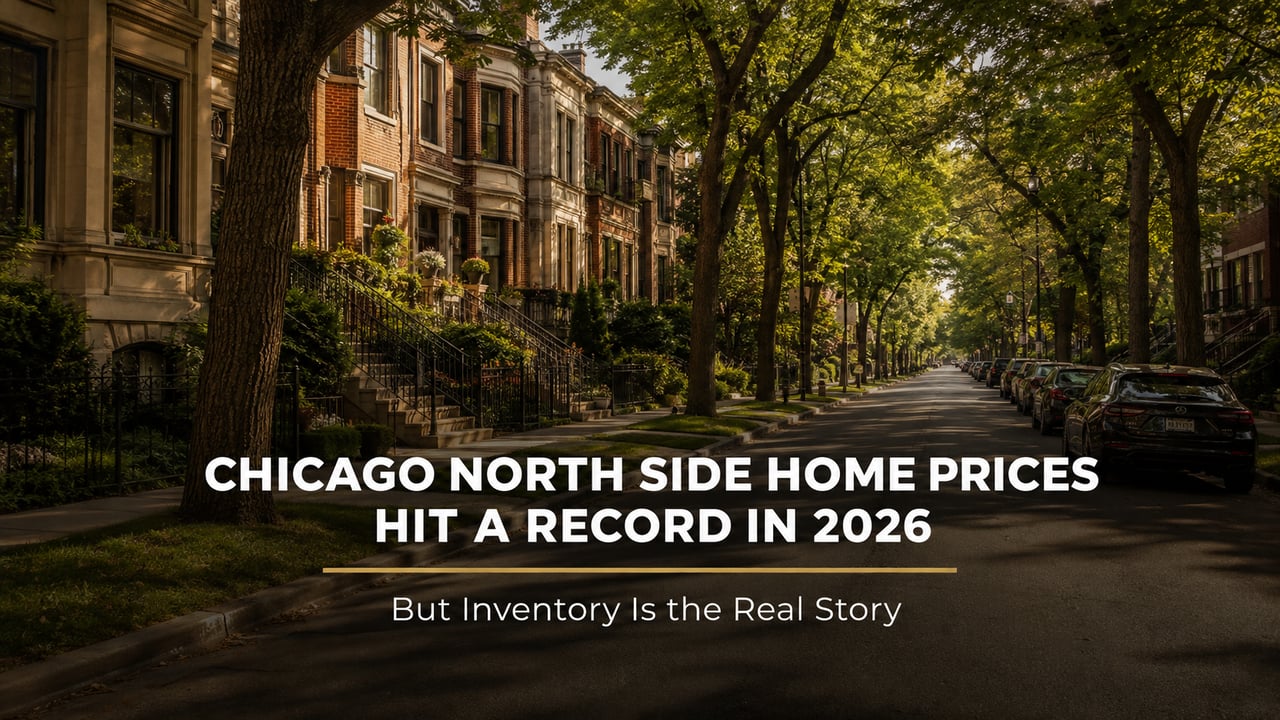
North Side Chicago home prices hit a record $500,000 in Q2 2026 while inventory fell 22.8%. Here is what the numbers mean for buyers and sellers.

Market Updates
Chicago has grown three years in a row - but growth is slowing, and the housing market is doing something the headlines cannot explain.
I'm Dee Savic, your trusted Chicago real estate expert, and I'm here to guide you through your relocation journey. Discover why Chicago is the perfect city for you; from its diverse neighborhoods to its cultural vibrancy, Chicago offers an unmatched urban experience. Together, we'll find a community and home that fits your lifestyle and aspirations.