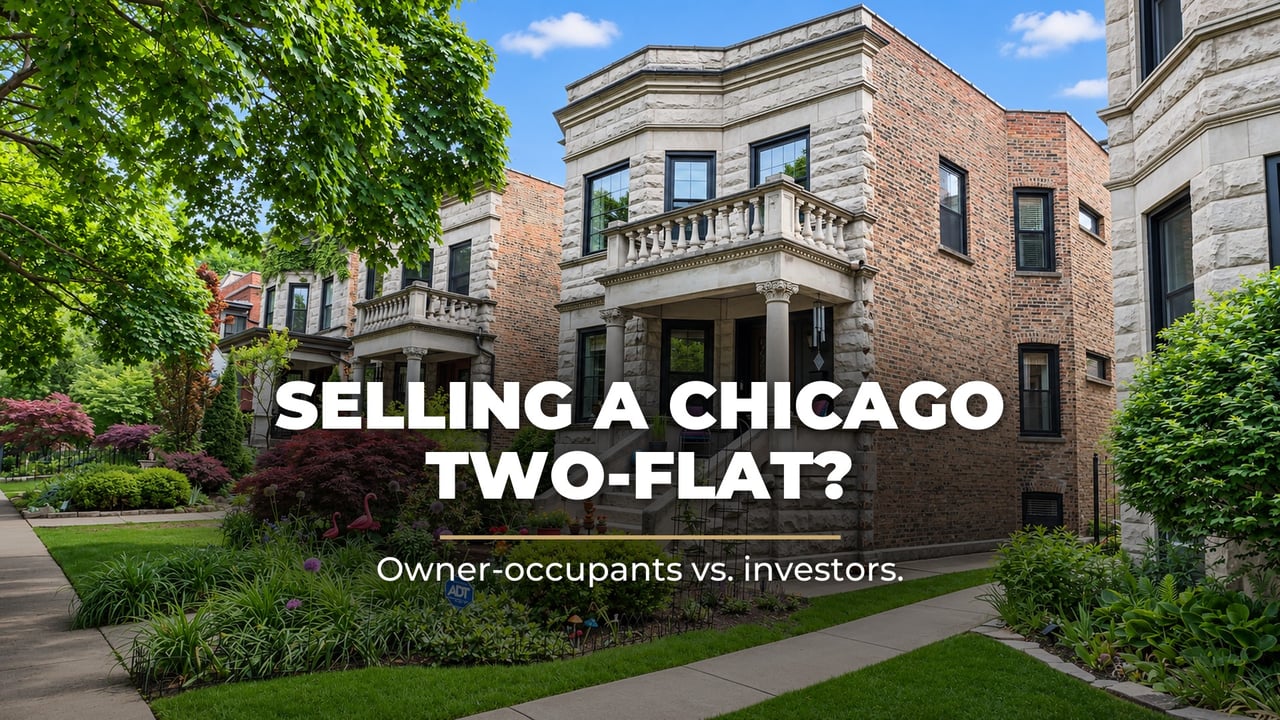
Can you sell a Chicago two-flat with tenants in it? Yes. The leases do not end when you sell, and you have to honor your tenants' rights. The buyer takes over the existing leases, so I start by reviewing who occupies each unit, when the leases end, and whether a buyer could move in. Those details help me advise you on pricing, marketing, and timing.
If you are selling a multi-family home with tenants, the buyer may want rental income, a place to live, or a building to turn into a house. Each buyer has different questions about the same property. I want your listing to answer those questions before they become obstacles to an offer.
In my MLS review, more than half of the 2-4 unit buildings sold in Lincoln Square, North Center, Lake View, and Edgewater went for more than the asking price, and the typical building went under contract in 9 days. Those results cover the combined areas and building types in the research. Here is how I would use that information to help you prepare your own building for sale.
I reviewed every closed sale of a 2-4 unit building in four North Side MLS areas from November 2025 to early November 2026. Most were two-flats and three-flats, and almost 9 out of 10 were built before 1940. The table gives you a starting point for understanding the market in each area.
Area | Sales | Median price | Sold over asking | Typical days on market |
|---|---|---|---|---|
Lincoln Square | 46 | $917,500 | 57% | 8 |
North Center | 58 | $1,100,000 | 53% | 9 |
Lake View | 62 | $1,372,500 | 47% | 9 |
Edgewater | 38 | $1,000,000 | 55% | 11.5 |
All four areas | 204 | $1,100,000 | 52% | 9 |
Source: MLS (MRED), closed 2-4 unit sales November 10, 2025 to November 6, 2026, in MLS areas Lincoln Square, North Center, Lake View, and Edgewater. At the time of research, deemed reliable but not guaranteed.
These figures include different building types, conditions, and rental situations, so the median is a starting point for our conversation. I would compare your property with recent sales that are similar in location, legal unit count, bedroom count, condition, and occupancy. Then I would look at how your leases and expenses may affect buyer interest.
About a third of the buildings sold under the asking price. That tells me sellers still need to be realistic, even when nearby buildings sell quickly. I would use the closest comparable sales to recommend a price, and you would decide where to list.
A Chicago two-flat is a building with two separate units, and its appeal can extend to several kinds of buyers. When I prepare the listing, I consider how each buyer would use the building and whether the current occupancy supports that plan.
These buyers want a home with rental income to help cover ownership costs. They care about the layout, light, kitchen, outdoor space, and block, along with what the other unit earns. I also want them to understand when they could realistically move in.
An FHA loan may allow an eligible buyer to put down as little as 3.5% on a qualifying 2-4 unit building, with occupancy generally required within 60 days. The buyer and property must meet the lender's requirements, including applicable loan limits and occupancy rules. I would want the buyer's lender to review the financing and move-in plan before you rely on the offer.
Investors focus on rental income, operating expenses, lease terms, and repairs. A well-kept building with reliable rent records gives them more information to work with. I want them to be able to understand what the building earns and what it costs to own.
In the sales I reviewed, 57 of the 204 buildings were bought with cash, more than 1 in 4. Buildings purchased with cash sold over asking 65% of the time, compared with 49% for purchases with a regular mortgage. Those figures describe the financing used; they do not tell us whether each cash buyer was an investor or planned to live there.
Some buyers look for a two-flat they can turn into a single-family home, often called a deconversion. Some listings in my research mentioned that possibility. Before marketing your building that way, I would want the buyer to understand that zoning, permits, tenant matters, and the proposed work need professional review.
I shape the marketing around the uses your building can reasonably support. Photos and floor plans can help a buyer picture living there, while clear lease and expense information helps an investor evaluate the property. My 2-4 unit specialist page explains more about how I market these buildings.
No, they do not. When you sell, you have to honor your tenants' rights, and the buyer takes over as landlord under the same leases. I ask you to gather the leases, amendments, deposit records, and any other written tenant agreements before we list. Your attorney should review the obligations that carry through the sale and handle the required deposit accounting and notices.
For buildings covered by the Chicago Residential Landlord and Tenant Ordinance's access rules, landlords generally must give at least two days notice before showing a unit to buyers. Owner occupancy can affect which rules apply, and the lease also matters. Your attorney can confirm the requirements for your building before we set the showing plan.
I want your tenants to know what to expect throughout the sale. I coordinate access, communicate the schedule, and attend every showing myself. My post on why your listing agent should be at every showing explains how that helps both the seller and the people living in the building.
I would weigh buyer demand against the income you could lose while a unit sits empty. An investor may welcome existing tenants and documented rent payments. A buyer who wants to live there needs an available unit within a timeframe that works with the lease, financing, and contract.
Before you promise vacancy or make a decision about renewing a lease, I would ask your attorney to review your options and any required notices. A lease end date alone may not settle when a unit can be delivered vacant. I explain the likely marketing tradeoffs, and you decide how you want to proceed.
I recommend involving your attorney while we are preparing the listing. Ask about your leases, deposits, and how showings will work with your tenants. That review can help us set a timeline you can realistically follow.
I want the building's records organized before buyers start asking for them. Clear records help me answer questions consistently and help buyers evaluate the income, expenses, and condition.
If there is a garden unit, I would want its legal status clarified before we describe it as an income-producing unit. How the space can legally be used may affect the buyer's plans and the lender's review. Your attorney and the appropriate professionals can help confirm the records.
I start with nearby 2-4 unit sales and look closely at the differences that could affect your price. A building with an available owner's unit may appeal to different buyers than a fully leased building. I explain what the comparable sales support, and you choose the asking price.
I plan the photos, video, floor plans, and description around what buyers need to understand. That includes how the units live, what income is documented, and what work may be ahead. Before you spend money updating a unit, I would help you consider whether the work is likely to improve its appeal.
If you are weighing repairs, my post on renovating or selling as-is in Chicago can help you prepare for that conversation. My buyer's guide to Chicago two-flats also explains the questions buyers bring to these properties.
I discuss the showing plan with you before the building goes on the market. Then I coordinate with your tenants and attend every showing, so buyers can ask questions while the people living there know who is entering their homes. If access becomes difficult, I work with you and your attorney on the next steps.
I look at price alongside financing, contingencies, closing timing, and any request for a vacant unit. A cash offer still needs careful review, and a financed offer needs a lender who understands the building and the buyer's intended use. You decide which offer best fits your goals after I explain the tradeoffs.
My posts on comparing multiple offers and appraisal gaps explain more about that review. For a tenant-occupied building, I also want the contract's occupancy terms to match what you can legally deliver.
Over the last 12 months, 2-4 unit buildings in Lincoln Square, North Center, Lake View, and Edgewater sold for a median of $1,100,000, based on the MLS. Medians ranged from $917,500 in Lincoln Square to $1,372,500 in Lake View.
Yes. The leases do not end when you sell, and you have to honor your tenants' rights. The buyer takes over as landlord, and the leases and security deposits transfer at closing. Your attorney handles the deposit credit and the notice to tenants.
Under the Chicago Residential Landlord and Tenant Ordinance, landlords generally give two days notice before showing a unit to buyers. Different rules can apply if the owner lives in a small building, so check your lease and talk to your attorney.
Usually three kinds of buyers: people who want to live in one unit and rent the other, investors who buy for the rent, and buyers who want to turn the building into one house. More than 1 in 4 North Side 2-4 unit buildings sold in the last 12 months were bought with cash.
Yes. FHA loans cover buildings with 1 to 4 units. The buyer can put down as little as 3.5% if they move into one of the units within 60 days.
If you own a two-flat or three-flat on the North Side, I would be happy to review recent sales, your building's condition, and the current leases with you. We can talk through who is likely to buy it and what you may want to prepare before listing. You decide whether the timing works for you.
Start with a free home value review or schedule a complimentary consultation. You can also call or text me at 773.719.0989.
This post is general information, not legal advice. Talk to your real estate attorney about your leases and tenants.
I am Dee Savic, a Chicago Realtor® with Baird & Warner. I have more than 24 years of real estate experience, have lived in Chicago for more than 27 years, and have closed more than 300 transactions. I help buyers, sellers, downsizers, investors, and relocation clients across Chicago, including Lincoln Park, Lakeview, Lincoln Square, Ravenswood, North Center, Roscoe Village, Andersonville, Uptown, Bucktown, Wicker Park, and the Gold Coast.
Dee Savic
Realtor® | Baird & Warner
4553 N. Lincoln Ave, Chicago, IL 60625
773.719.0989
[email protected]
deesavic.com
Seller's Advice
How much Chicago homeowners have gained, and what it can mean for your next move

Buying
Neighborhoods, getting around without a car, parking and dibs, winter, the real cost, schools, lead pipes, and property taxes, from a local since 1998
Seller Advice
What 12 months of MLS sales show for Logan Square condo and house sellers

Seller's Advice
A day-by-day checklist from a Chicago listing agent, one small step at a time

Relocation
ZooLights, Christkindlmarket, the Lights Festival, free museum days and new spots, with dates and prices
Chicago Market
What North Side 2-4 unit buildings sold for, who buys them, and how to handle tenants

Selling
What 12 months of MLS sales show for condos, vintage houses and new construction

Selling
Attorney review, inspection, appraisal, closing paperwork and moving out, step by step
Selling
My room-by-room checklist for listing photos, video and 3D tours
I'm Dee Savic, your trusted Chicago real estate expert, and I'm here to guide you through your relocation journey. Discover why Chicago is the perfect city for you; from its diverse neighborhoods to its cultural vibrancy, Chicago offers an unmatched urban experience. Together, we'll find a community and home that fits your lifestyle and aspirations.