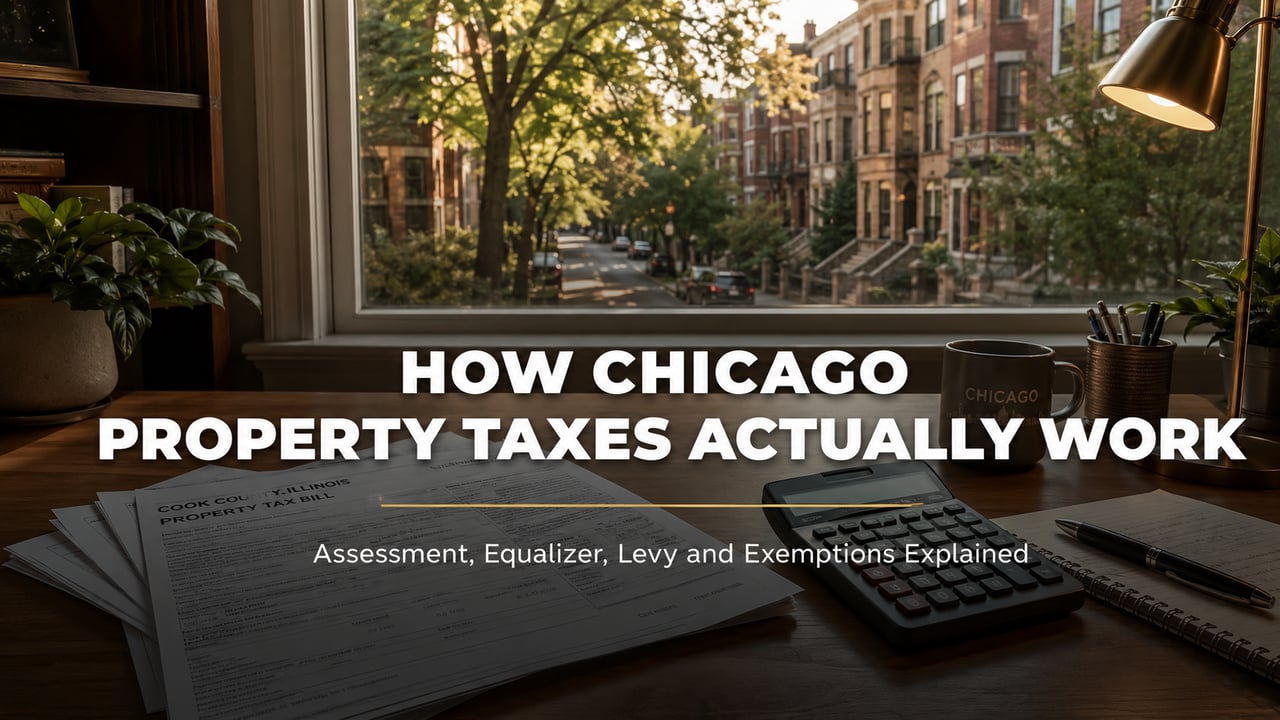
How do Chicago property taxes actually work? Your Cook County property tax bill is your assessed value multiplied by the state equalizer, minus your exemptions, multiplied by the local tax rate set by every taxing body that has a claim on your property. Four components - and only two of them are where you can actually move the number. Understanding which two changes how you think about buying, selling, appealing, and owning property in Chicago.
I am Dee Savic, a Realtor with Baird & Warner. I have lived in Chicago for 27 years and worked with buyers and sellers across Chicago's neighborhoods for 24 of them. Property taxes come up in nearly every transaction I handle, and the single most common source of confusion is that homeowners conflate their assessed value with their tax bill - as if the two were the same thing. They are not. This guide explains each component of your bill, which ones you can influence, and how to use this knowledge when you are buying or selling a Chicago home.
For related guides in this series see my Cook County property tax bill walkthrough, my 30-year explainer on why Chicago property taxes keep rising, and my property tax guide for Chicago buyers.
Every Cook County property tax bill is calculated the same way:
The Cook County Property Tax Formula
(Assessed Value × State Equalizer - Exemptions) × Local Tax Rate = Tax Bill
Each of those four components comes from a different source, moves on a different schedule, and is influenced by different decisions. Here is what each one means.
Your assessed value is the Cook County Assessor's estimate of your property's fair market value, multiplied by the assessment level. For residential properties in Cook County, the assessment level is 10%. So if the Assessor believes your home is worth $500,000, your assessed value is $50,000.
The Cook County Assessor's Office sets assessed values for every parcel in the county - approximately 1.8 million properties. The Assessor uses mass appraisal models that analyze comparable sales, building characteristics, location, and other factors to estimate market value. Individual properties are not physically inspected every cycle.
Cook County reassesses every property on a triennial (three-year) cycle, rotating through three geographic triads:
This means if you own property in Chicago - Lakeview, Lincoln Park, Lincoln Square, Rogers Park, Edgewater, the South Loop, Wicker Park, Logan Square, or anywhere else in the city - your assessed value was last updated in 2024 and will not be reassessed again until 2027, unless your property undergoes a significant change such as a permit, division, or new construction.
This is the component you can influence. If you believe your assessed value is higher than it should be - meaning the Assessor's implied market value is higher than what comparable properties are actually selling for - you have the right to appeal. You can appeal at the Assessor level during your reassessment year, and at the Cook County Board of Review every year regardless of whether your township is being reassessed. Filing is free and does not require an attorney. See the official appeal calendar for your township's current deadlines.
The state equalizer - officially called the Illinois Department of Revenue equalization factor - is a multiplier applied to your assessed value after the Assessor sets it. Its purpose is to bring Cook County's aggregate assessed values into alignment with the statutory assessment level (33.33% of market value) as required by Illinois law.
The equalizer is calculated annually by the Illinois Department of Revenue based on a study of actual sale prices versus assessed values across the state. Cook County's equalizer has historically run around 2.9 to 3.0, which means the Assessor's 10% assessment is multiplied by approximately 2.9 to bring it to the 33.33% statutory level. The result is called your Equalized Assessed Value, or EAV.
Using the example above: a $500,000 home assessed at $50,000, multiplied by an equalizer of 2.9163, produces an EAV of approximately $145,815.
You cannot change the equalizer. It applies uniformly to every property in Cook County and is set by the state, not by the county. It is not a lever available to individual property owners.
Exemptions reduce your EAV before the tax rate is applied. They are the single most actionable component of your tax bill for most homeowners - and the one most commonly left unclaimed or allowed to lapse.
Here are the most common exemptions available to Cook County property owners:
Exemption | Who Qualifies | How It Works |
|---|---|---|
Homeowner Exemption | Owner-occupants of primary residence | Reduces EAV by $10,000 |
Senior Citizen Exemption | Owner-occupants 65 or older | Additional reduction of $8,000 in EAV |
Senior Freeze Exemption | Seniors 65+ with household income under $65,000 | Freezes EAV at base year level - prevents increases |
Persons with Disabilities | Owner-occupants with qualifying disability | Reduces EAV by $2,000 |
Veterans with Disabilities | Veterans with service-connected disability rating | Reduction varies by disability rating - up to 100% exemption |
Longtime Homeowner | Owner-occupants for 10+ years with income limits | Additional EAV reduction beyond Homeowner Exemption |
Check your current exemptions at the Cook County Assessor's exemptions page. The Homeowner Exemption is automatic for most owner-occupants but can drop off after a sale, a refinancing error, or a system issue. If you purchased your home in the last two years and the Homeowner Exemption is not on your bill, apply immediately.
Exemptions are the second component you can influence - and they are often the fastest, lowest-effort way to reduce your tax bill. A missing Homeowner Exemption on a $500,000 Chicago condo can cost the owner hundreds of dollars per year.
The local tax rate - also called the composite tax rate or aggregate levy rate - is determined by every taxing body that collects property taxes from your property. In Chicago, this typically includes Chicago Public Schools, the City of Chicago, the Chicago Park District, the Metropolitan Water Reclamation District, the Cook County Forest Preserve, Cook County itself, and several others.
Each of these bodies submits an annual levy - the total amount they want to collect. The combined levy of all taxing bodies is divided by the total EAV of all taxable properties in their jurisdiction to produce the tax rate. Your tax bill is your EAV multiplied by that composite rate.
You cannot change the local tax rate as an individual property owner, though you can influence it indirectly through local elections and public participation in budget processes. The rate changes every year based on what taxing bodies request and what the total EAV base is. As the Treasurer's 30-year study showed, levy growth - not assessment growth - has been the primary driver of rising property tax bills in Cook County over the past three decades.
Example: Owner-Occupied Condo in Lakeview, Chicago
Estimated market value: $500,000
Assessment level (10%): $50,000
State equalizer (approx. 2.9163): $50,000 × 2.9163 = $145,815 EAV
Homeowner Exemption: - $10,000
Taxable EAV: $135,815
Composite tax rate (approx. 6.5% for this example): × 0.065
Estimated annual tax bill: approximately $8,828
Note: The actual tax rate varies by property location and taxing districts. This example uses an approximate rate for illustration purposes only. Always verify your actual rate on your tax bill or at cookcountytreasurer.com.
Notice what happens if the Homeowner Exemption is missing: the taxable EAV rises to $145,815 and the estimated annual bill rises to approximately $9,478 - a difference of about $650 per year. Over five years of ownership, that is more than $3,000 left on the table from a single unclaimed exemption.
If you believe your assessed value is too high, Cook County provides two levels of appeal:
Filed directly with the Assessor's Office during your township's annual assessment window. In reassessment years this is typically the most powerful appeal opportunity because the Assessor is actively recalculating values based on current market data. The Assessor's appeal window is approximately 30 days per township and varies by year. Check your township's current deadline on the official appeal calendar.
An independent three-member elected body that provides a second level of review. You can file a Board of Review appeal every year regardless of whether your township is in a reassessment year. The Board of Review's calendar runs township by township, typically from late summer through fall. For Rogers Park and Edgewater, the current Board of Review window closes September 1, 2026 - see my Rogers Park and Edgewater appeal deadline guide for details.
Both levels of appeal are free to file and do not require an attorney. The Board processed a record 290,533 appeals in 2025.
The tax bill on a listing reflects what the seller paid - based on their assessed value, their exemptions, and last year's tax rate. When you buy, three things can change:
For a full buyer-focused breakdown see my Chicago property taxes guide for buyers. Start with my free Chicago Buyer's Course for the full picture of what it costs to own a home in Chicago.
Property taxes are prorated at closing based on the number of days each party owns the property during the tax year. Because Cook County bills one year behind, the second-installment bill you receive in the fall of 2026 covers Tax Year 2025. If you sell mid-year, the buyer typically receives a credit for the seller's share of the unpaid tax period.
Understanding your actual tax bill - not what the listing sheet says - is essential for modeling your net proceeds accurately. Start with a free home value review and see my Chicago seller closing costs guide for the full net proceeds picture. If your sale may trigger a capital gains tax event see my Chicago capital gains tax guide.
Term | Plain-Language Definition |
|---|---|
Assessed Value (AV) | The Cook County Assessor's estimate of your property's market value multiplied by 10% (the residential assessment level). |
State Equalizer | A multiplier set annually by the Illinois Department of Revenue to bring Cook County assessments to the 33.33% statutory level. Applied uniformly to all properties. |
Equalized Assessed Value (EAV) | Your assessed value after the state equalizer is applied. This is the number exemptions are subtracted from and the tax rate is applied to. |
Exemption | A reduction to your EAV based on how you use the property (primary residence, senior occupant, disability status, etc.). Reduces the taxable base before the rate is applied. |
Tax Rate / Composite Rate | The combined levy rate of all taxing bodies that collect from your property - schools, parks, city, county, and others. Set annually based on what those bodies request. |
Levy | The total dollar amount a taxing body (school district, park district, city, etc.) asks to collect from all property owners in its jurisdiction in a given year. |
PIN | Property Index Number. Your 14-digit unique property identifier used across all Cook County tax systems. |
Triennial Reassessment | Cook County's three-year cycle for updating all property assessments. Each property is fully reassessed once every three years based on its geographic triad. |
Board of Review | An independent three-member elected body that provides a second level of assessment appeal after the Assessor's decision. Free to file. Available to all Cook County property owners annually. |
TIF District | Tax Increment Financing district. An area where the assessed value is frozen and future growth in tax revenue above that frozen amount is diverted to a special fund rather than to schools, parks, and other taxing bodies. |
Your Cook County property tax bill is calculated by multiplying your assessed value by the state equalizer to get your Equalized Assessed Value (EAV), subtracting your exemptions from the EAV, and multiplying the result by the composite tax rate set by all local taxing bodies. Of the four components - assessed value, equalizer, exemptions, and tax rate - only two are where you can move the number: your assessed value (by appealing) and your exemptions (by making sure all of yours are claimed).
Residential properties in Cook County are assessed at 10% of estimated fair market value. A home the Assessor believes is worth $500,000 has an assessed value of $50,000. The state equalizer (approximately 2.9163 in recent years) is then applied to bring that to the statutory 33.33% level, producing an Equalized Assessed Value of approximately $145,815.
Cook County reassesses on a triennial cycle. City of Chicago properties were last reassessed in 2024 and will next be reassessed in 2027. Even in non-reassessment years, you can still appeal your assessed value annually at the Board of Review.
The most common exemptions are the Homeowner Exemption (reduces EAV by $10,000 for primary residences), the Senior Citizen Exemption (additional $8,000 EAV reduction for owners 65+), and the Senior Freeze Exemption (freezes EAV for qualifying seniors). Check and apply for all exemptions you qualify for at the Cook County Assessor's website.
You can appeal at the Assessor level during your township's annual window (approximately 30 days, check the official calendar) or at the Board of Review level every year. Both are free to file and do not require an attorney. Visit cookcountyboardofreview.com to file or check current deadlines.
Because the tax rate - set by the combined levies of 562 local government bodies - can increase even when your assessed value stays the same. If taxing bodies collectively increase what they ask to collect, your bill goes up proportionally even with a flat assessment. For the full 30-year explanation see my guide to why Chicago property taxes keep rising.
Taxes are prorated at closing based on the number of days each party owns the property during the tax year. Because Cook County bills one year in arrears, buyers typically receive a credit from the seller for the seller's portion of the current year's unpaid taxes. The exact amount depends on the closing date and the most recent available tax bill. See my Chicago seller closing costs guide for how this affects net proceeds.
Buyers: start with my free Chicago Buyer's Course for a complete picture of what it actually costs to own a home in Chicago - taxes, HOA fees, insurance, and all.
Sellers: start with a free home value review to understand what your home is worth and how taxes factor into your net proceeds.
Or schedule a complimentary and confidential consultation here.
Property tax information in this post reflects Cook County assessor, treasurer, and Board of Review policies and procedures as of August 2026. Tax rates, equalizers, exemption amounts, and deadlines change annually. Always verify current information directly with the Cook County Assessor's Office at cookcountyassessoril.gov and the Cook County Treasurer at cookcountytreasurer.com. This post is for informational purposes only and does not constitute legal, financial, or tax advice. Consult a qualified tax advisor for guidance specific to your situation.
Dee Savic is a Realtor with Baird & Warner, a 24+ year real estate professional, and a 27+ year Chicago resident with 300+ closed transactions and hundreds of five-star reviews. She specializes in helping buyers and sellers across Chicago's neighborhoods.
Dee Savic
Realtor® | Baird & Warner
4553 N. Lincoln Ave, Chicago, IL 60625
773.719.0989
[email protected]
deesavic.com
Neighborhood Guides
What homes sold for, the 606, the Blue Line, types of homes, and Bucktown vs. Wicker Park
Buying
Real 2026 sales in Lincoln Park, Lakeview, North Center, Roscoe Village, Lincoln Square, Irving Park, Edgewater, and Andersonville

Buying
Where the unit sits, elevators, pets, wind and sound, views, parking, and building rules

Buying
The real monthly cost, yards, winter, parking, competition, long-term value, and choosing the right neighborhood
Neighborhood Guides
The six parts of 60613, from the lakefront to Damen, and what homes sold for in each in 2026

Neighborhood Guides
Where Buena Park is, what homes sold for in 2026, Hutchinson Street, the lakefront, schools, and safety

Buying
Five years of Chicago prices, where you can and cannot negotiate, and how to handle a 7.40% mortgage rate

Local Events
Dates, times, and exact blocks for Halloween events in Lakeview, Lincoln Park, Lincoln Square, Ravenswood, North Center, Andersonville, and Edgewater
Neighborhood News
The Camry Lot expansion, the 2027 All-Star Game, parking rules, and what homes nearby sold for in 2026
I'm Dee Savic, your trusted Chicago real estate expert, and I'm here to guide you through your relocation journey. Discover why Chicago is the perfect city for you; from its diverse neighborhoods to its cultural vibrancy, Chicago offers an unmatched urban experience. Together, we'll find a community and home that fits your lifestyle and aspirations.