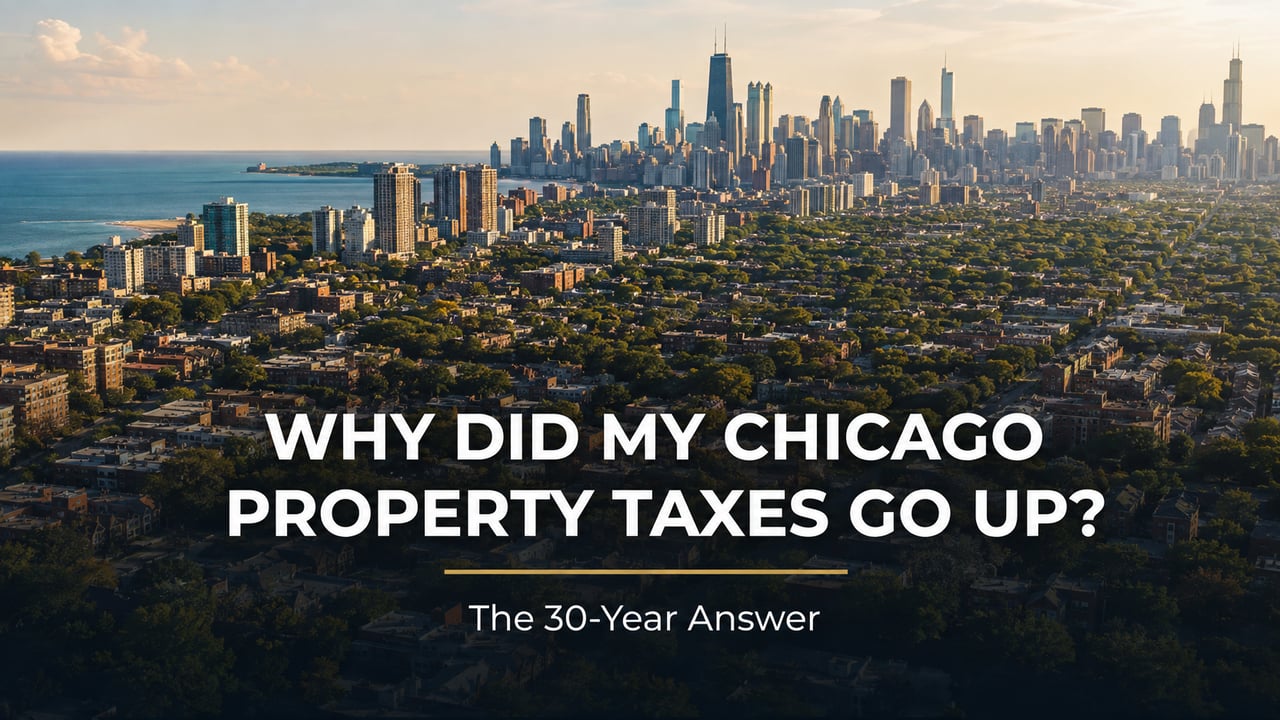
Why do Chicago property taxes keep going up? Cook County property taxes grew 182% between 1995 and 2024 - more than double the rate of inflation, which rose 91% over the same period, and faster than wages, which grew 161%. The largest single driver was not rising home values. It was levy growth - the amount local governments decided they needed to collect, year after year, at a pace that outran almost every other measure of economic growth.
I am Dee Savic, a Realtor with Baird & Warner. I have lived in Chicago for 27 years and worked with buyers and sellers across Chicago's neighborhoods for 24 of them. Property taxes come up in nearly every transaction I handle - buyers trying to calculate real carrying costs, sellers modeling net proceeds, and long-time owners who feel like their bill has grown faster than everything else in their financial life. They are right. This post explains why, using data from the Cook County Treasurer's 30-year study released March 30, 2026.
In 1995, Cook County taxing bodies collected a combined $6.8 billion in property taxes. By 2024, that number had grown to $19.2 billion. That is a 182% increase over 30 years.
Over the same period:
If Cook County's total property tax levy had grown only at the rate of inflation, it would be approximately $10.1 billion today - about $9 billion less than it actually is.
Those numbers are not abstract. Every dollar of levy growth gets passed directly to property owners in the form of higher bills.
Most homeowners assume that rising property taxes mean their home's assessed value went up. Sometimes that is true. But it is rarely the whole story - and for many homeowners it is not the story at all.
Here is how Cook County property taxes actually work:
Every year, 562 local government bodies in Cook County - school districts, park districts, municipalities, the county itself, fire protection districts, community colleges, and others - submit a levy. That levy is the amount they want to collect. The total of all those levies is the total property tax burden for Cook County. Every property owner pays a share of that total based on their assessed value relative to everyone else.
Your assessment determines your share. The levy determines the total. And the levy is what has grown at twice the rate of inflation.
So even if your home's assessed value stayed flat, your bill could still go up - because the total amount being collected grew, and your flat share of a bigger number is still a bigger number.
Cook County Property Tax Growth vs. Other Measures (1995-2024)
Property taxes: +182%
School district levies: +189%
Wages: +161%
Inflation: +91%
TIF district taxes: +1,000%
Source: Cook County Treasurer's Office Study, March 30, 2026
School district levies grew 189% between 1995 and 2024, making them one of the two largest drivers of the overall increase. A significant portion of that growth is tied to public pension funding mandates. Illinois gives a lower percentage of state money to schools than any other state, which pushes more of the funding burden onto local property taxes. Chicago Public Schools alone went from approximately $2.9 billion in levies in 1995 to nearly $8.9 billion in 2024.
TIF district taxes grew by approximately 1,000% between 1995 and 2024, making them by far the fastest-growing category in the study. TIF districts work by freezing the assessed value of properties within a designated area for up to 23 years. During that period, all other taxing bodies - schools, parks, the county - collect based on the frozen value, even if the actual value rises significantly. The additional tax revenue from growth above the frozen value goes entirely to the TIF fund. This effectively shifts the tax burden onto property owners outside TIF districts. The 400-plus TIF districts in Cook County accounted for more than 9.5% of all county property taxes in 2024, up from 2.4% in 1995.
Illinois enacted the Property Tax Extension Limitation Law (PTELL) in Cook County in 1994 to limit annual property tax increases to 5% or the rate of inflation, whichever is less. But local officials took advantage of loopholes in the law to enact increases that substantially exceeded that limit. These loopholes include voter-approved referendums, new construction additions, and a 2021 law that allows non-home-rule agencies to "recapture" money refunded in previous years to property owners who successfully appealed their assessments. Out of 940 units of government in Cook County, 676 increased their levies.
Even though the levy is the primary driver of total tax growth, your assessed value still matters because it determines your share of that levy. If your assessed value is higher than it should be relative to comparable properties, you are paying more than your fair share of an already-growing total.
This is why appealing your assessment - at the Assessor level when your township is reassessed, or at the Board of Review level during the annual appeal window - is worth doing if your value appears inflated. The Cook County Board of Review offers a free, independent review of assessments. The Board processed a record 290,533 appeals in 2025.
It is also why verifying your exemptions matters. The Homeowner Exemption, Senior Exemption, Senior Freeze, and other exemptions all reduce your assessed value - which reduces your share of the levy. If any of your exemptions have dropped off, you are overpaying.
For a full breakdown of how to read your current bill and verify your exemptions see my Cook County property tax bill guide.
If you are buying: The tax bill on a listing reflects what the current owner paid last year. It may not reflect a reassessment that just happened or levies that increased this year. Model your carrying costs using the most current available bill, not the listing sheet. And understand that Cook County taxes will almost certainly continue to grow - build that into your long-term ownership math. For more on how taxes factor into your buying decision see my Chicago property taxes guide for buyers.
If you are selling: Taxes are prorated at closing. Buyers will ask about the current bill and, in reassessment years, sometimes about what the bill is likely to be after reassessment. Understanding your actual tax picture - including any pending changes - helps you price accurately and negotiate from a position of knowledge. Start with a free home value review to understand your full financial picture before you list. And if your sale may trigger a capital gains tax event see my Chicago capital gains tax guide.
Because your assessment determines your share of the total levy - not the total itself. If local government bodies collectively increased what they asked to collect, your bill can go up even if your assessed value stayed the same. The total Cook County levy grew from $6.8 billion in 1995 to $19.2 billion in 2024, driven primarily by school district levies, TIF district growth, and loopholes in the state's tax limitation law.
According to the Cook County Treasurer's 30-year study released March 30, 2026, the biggest driver is levy growth - the amount local governments choose to collect each year. School district levies grew 189% between 1995 and 2024. TIF district taxes grew approximately 1,000% over the same period. These increases are passed directly to property owners.
A Tax Increment Financing (TIF) district freezes the assessed values within a designated area, diverting the tax revenue from value growth above that frozen level into a TIF fund. Other taxing bodies - schools, parks, the county - continue collecting based on frozen values. This shifts a greater share of the total levy burden onto property owners outside TIF districts. TIF district taxes in Cook County grew approximately 1,000% between 1995 and 2024 and now account for about 9.5% of all county property taxes, up from 2.4% in 1995.
Yes. You can appeal at the Assessor level when your township is reassessed and at the Board of Review level during the annual appeal window. Filing is free and does not require an attorney. Visit cookcountyboardofreview.com for current deadlines and to file online.
The most common exemptions include the Homeowner Exemption (reduces assessed value by $10,000 for primary residences), the Senior Citizen Exemption, the Senior Freeze Exemption, the Persons with Disabilities Exemption, and Veterans Exemptions. Check your current exemptions at the Cook County Assessor's website. Missing exemptions are one of the most common and costly oversights among Chicago homeowners.
The structural drivers - pension funding obligations, school district levies, TIF district growth, and loopholes in the state's tax limitation law - have not been resolved. The Cook County Treasurer's study called on state lawmakers to pass significant tax reform and urged local taxing agencies to cut spending. Until those structural changes occur, the trend that produced a 182% increase over 30 years is likely to continue.
Buyers: start with my free Chicago Buyer's Course for a complete picture of what it actually costs to own a home in Chicago - taxes included.
Sellers: start with a free home value review to understand what your home is worth and how taxes factor into your net proceeds.
Or schedule a complimentary and confidential consultation here.
Data in this post is sourced from the Cook County Treasurer's Office 30-year study released March 30, 2026, and from multiple news organizations that reported on that study including WBEZ, the Chicago Sun-Times, CBS Chicago, WTTW, and the Daily Herald. All figures are attributed to the Treasurer's study. This post is for informational purposes only and does not constitute legal, financial, or tax advice. Consult a qualified tax advisor for guidance specific to your situation.
Dee Savic is a Realtor with Baird & Warner, a 24+ year real estate professional, and a 27+ year Chicago resident with 300+ closed transactions and hundreds of five-star reviews. She specializes in helping buyers and sellers across Chicago's neighborhoods.

Dee Savic
Realtor® | Baird & Warner
4553 N. Lincoln Ave, Chicago, IL 60625
773.719.0989
[email protected]
deesavic.com
Neighborhood Guides
What homes sold for, the 606, the Blue Line, types of homes, and Bucktown vs. Wicker Park
Buying
Real 2026 sales in Lincoln Park, Lakeview, North Center, Roscoe Village, Lincoln Square, Irving Park, Edgewater, and Andersonville

Buying
Where the unit sits, elevators, pets, wind and sound, views, parking, and building rules

Buying
The real monthly cost, yards, winter, parking, competition, long-term value, and choosing the right neighborhood
Neighborhood Guides
The six parts of 60613, from the lakefront to Damen, and what homes sold for in each in 2026
Neighborhood Guides
Where Buena Park is, what homes sold for in 2026, Hutchinson Street, the lakefront, schools, and safety
Buying
Five years of Chicago prices, where you can and cannot negotiate, and how to handle a 7.40% mortgage rate

Local Events
Dates, times, and exact blocks for Halloween events in Lakeview, Lincoln Park, Lincoln Square, Ravenswood, North Center, Andersonville, and Edgewater
Neighborhood News
The Camry Lot expansion, the 2027 All-Star Game, parking rules, and what homes nearby sold for in 2026
I'm Dee Savic, your trusted Chicago real estate expert, and I'm here to guide you through your relocation journey. Discover why Chicago is the perfect city for you; from its diverse neighborhoods to its cultural vibrancy, Chicago offers an unmatched urban experience. Together, we'll find a community and home that fits your lifestyle and aspirations.