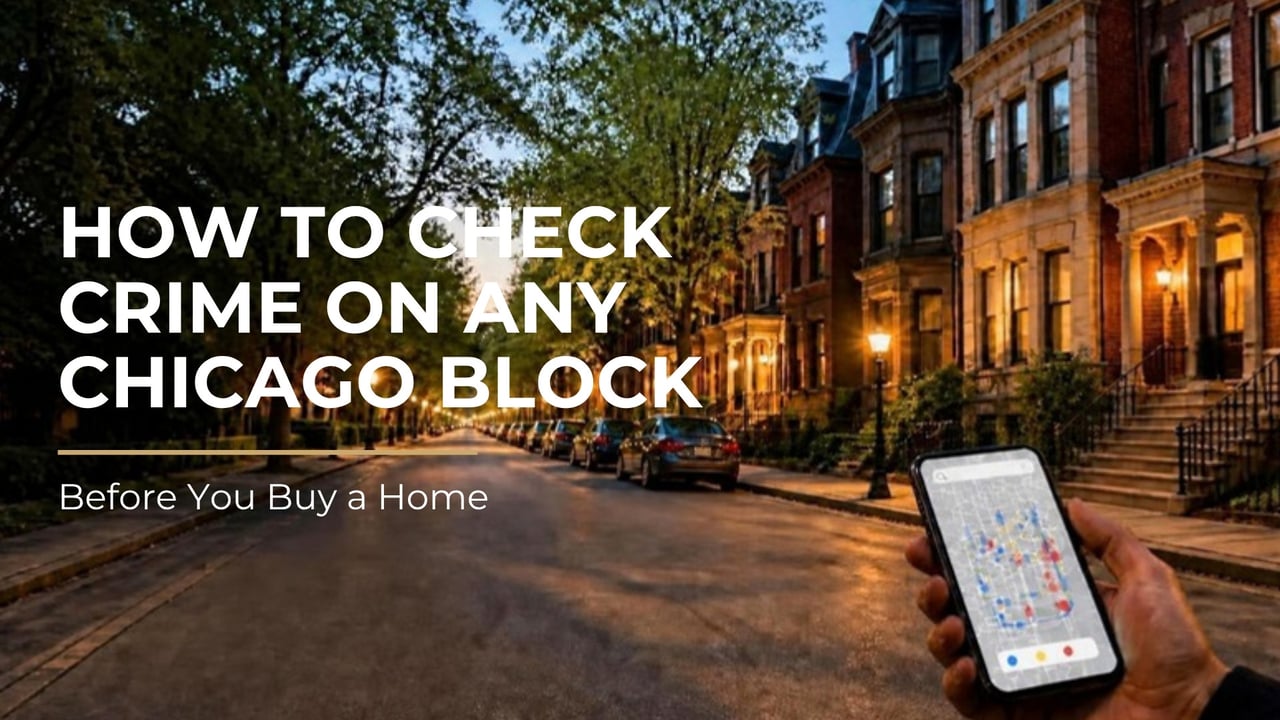
Use the Chicago Police Department's free CLEARMAP site and the City of Chicago's crime data portal to look up reported incidents near the address, then confirm what you find by visiting the block at different times and attending a local police beat meeting.
Almost every buyer I work with asks some version of the same question: "Is this block safe?" It is a fair question, and it deserves a real answer. But safe means something different to every buyer. One person is thinking about walking home from the train at night, another is thinking about packages on the porch, and another is thinking about parking on the street.
That is why I do not tell buyers whether a block or a neighborhood is safe. What I do is show every client the same official sources, the same way, for every address, so you can look at the information yourself and decide what matters to you. This guide walks you through exactly how to do that.
Chicago has two free, official places to look up reported crime. Both use the same underlying source, the Chicago Police Department's CLEAR system, which stands for Citizen Law Enforcement Analysis and Reporting. Neither requires an account.
Official Tool | What It Shows | Best For |
|---|---|---|
CLEARMAP (Chicago Police Department) | A map of reported crime from the past 365 days, plus summary statistics by police district, beat, ward, and community area | A quick visual look at the blocks around a specific home |
Crimes: 2001 to Present (City of Chicago Data Portal) | Every reported incident since 2001, with the type of crime, date, and block | Filtering by crime type, date, or street in a spreadsheet-style view |
CAPS Beat Meetings (Chicago Police Department) | In-person community meetings held for each police beat | Hearing directly from neighbors and beat officers about what is happening locally |
You will also find crime maps on private real estate and neighborhood apps. I suggest starting with the official sources above, because you can see exactly where the information comes from and what it does and does not include.
Go to CLEARMAP, the Chicago Police Department's public crime map, and open the Chicago Crime map. Find the address of the home you are considering and zoom in to the surrounding blocks. The map shows reported incidents from the past 365 days and is refreshed daily, with the most recent week held back.
CLEARMAP separates property crime, such as burglary, theft, and motor vehicle theft, from violent crime. Look at both, because they tell you different things. A block with a lot of reported car break-ins and a block with a lot of reported robberies may show a similar number of dots, but they are not the same situation.
CLEARMAP also has a Summary Statistics view that totals reported crime by police district, beat, ward, and community area. This is useful for seeing the bigger area around a home, not just the few blocks on your screen.
If you want more detail, the City of Chicago publishes the full dataset, Crimes: 2001 to Present, on its open data portal. It lists each reported incident with the date, the type of crime, a short description, and the block where it was reported. The data is updated daily and leaves out the most recent seven days.
You can filter the list by the block of the street you are looking at, by date, or by type of crime. For example, you could look only at the 4200 block of a street over the past year, or only at reported burglaries. It takes a few more minutes than the map, but it gives you a clearer picture of what was actually reported.
This is the step most people skip, and it is the most important one. Crime data is useful, but it is easy to misread. Here is what I want every buyer to understand before drawing conclusions.
The takeaway is simple: use the data as a starting point for your own questions, not as a final verdict on a block.
Chicago is divided into police districts, and each district is divided into smaller areas called beats. Through the city's CAPS program, which stands for Chicago Alternative Policing Strategy, each beat holds community meetings where residents and officers talk about what is happening locally. According to the Chicago Police Department, beats hold about six of these meetings a year.
You can find the beat for an address and the upcoming meeting schedule through the Chicago Police Department's beat meetings page. Meetings are open to the community, so you do not need to live there yet to attend. Sitting in on one meeting can tell you more about the everyday concerns on a block than any map, whether it is speeding on a side street, package theft, or a problem building.
Data gives you the history. Being there gives you the present. Before you make an offer, I suggest visiting the block at least once on a weekday evening and once on a weekend, not just during a showing on a sunny Saturday afternoon.
Walk the route you would take every day, such as from the home to the train, the grocery store, or the park. Notice the lighting, how busy the street is, and how the block feels to you at different times. If you see neighbors outside, it is fine to say hello and ask how they like living there. Most people are happy to tell you.
Look at the home itself, too. Ask about exterior lighting, door and window locks, garage security, and whether the building has a secured entry or cameras. These are practical questions for any home in any part of the city, and your inspector can point out anything that needs attention.
The most useful habit you can build is doing the same research, the same way, for every address on your list. Pull up CLEARMAP, look at the same time period, read the same types of incidents, and visit each block at similar times. That gives you a fair comparison based on information rather than a feeling from one showing.
It is the same approach I use with schools. School assignments depend on the exact address, so I always point buyers to the CPS School Locator and my guide to Chicago neighborhoods with the best-rated schools rather than making assumptions. Crime research works best the same way: specific to the address, based on official sources, and done consistently.
Checking crime data is one part of your research, along with the commute, the home's condition, the property taxes, and the price. If you are buying your first home, my guide on how to buy a home in Chicago walks through every step, and my closing costs guide shows what to budget beyond the down payment.
If you are moving to Chicago from another city, you may also find my list of 20 things to know before moving to Chicago helpful. My Chicago relocation page explains how I help out-of-town buyers research neighborhoods and homes before they ever fly in.
The Chicago Police Department's CLEARMAP site at gis.chicagopolice.org shows a map of reported crime from the past 365 days. The City of Chicago also publishes every reported incident since 2001 on its open data portal in the dataset called Crimes: 2001 to Present. Both are free and do not require an account.
Both CLEARMAP and the city's data portal are updated daily, but they leave out the most recent seven days. Incident classifications are based on preliminary information and can change after investigation.
No. To protect victims' privacy, incidents are shown at the block level only, and the city notes that map locations should be considered approximate.
I do not label any block or neighborhood as safe or unsafe, because that means something different to every buyer. Instead, I show every client the same official sources, such as CLEARMAP, the city's crime data portal, and CAPS beat meetings, so you can review the information yourself and decide what matters to you.
CAPS stands for Chicago Alternative Policing Strategy. Each police beat holds community meetings, about six a year according to the Chicago Police Department, where residents and officers discuss local concerns. Meetings are open to the community, and you can find the schedule on the Chicago Police Department's website.
Be careful. The Chicago Police Department's disclaimer says its crime dataset should not be used for comparisons over time, because classifications and reporting can change. Looking at the same recent time period for each home you are considering is a fairer comparison.
If you are looking at homes in Chicago and want help working through your research, I am happy to walk you through these tools for any address on your list. I can also help you compare homes on everything else that matters, from condition and taxes to price and resale.
If you are buying, start with my free Chicago Buyer's Course or my Buyer's Guide. You can also schedule a complimentary and confidential consultation here, or call or text me directly at 773.719.0989.
Information about CLEARMAP and the Crimes: 2001 to Present dataset comes from the Chicago Police Department and the City of Chicago Data Portal. Accurate at the time of research, deemed reliable but not guaranteed. Crime data is based on reported incidents and preliminary information, and should be reviewed and verified independently.
Dee Savic is a Realtor with Baird & Warner, a 24+ year real estate professional, and a 27+ year Chicago resident with 300+ closed transactions. She specializes in helping buyers, sellers, and relocation clients across Chicago's North and Northwest Sides, including Lincoln Square, Ravenswood, North Center, Roscoe Village, Irving Park, Lakeview, Lincoln Park, Andersonville, Uptown, and Edgewater.

Dee Savic
Realtor® | Baird & Warner
4553 N. Lincoln Ave, Chicago, IL 60625
773.719.0989
[email protected]
deesavic.com

Buyer Guides
Pre-approval, video tours, one focused trip, and a closing you can mostly handle from home

Neighborhood Guides
The pockets, the parks, the Blue Line, and what the 2026 numbers mean for buyers and sellers

Buyer Guides
Real sale prices vs resale, builder warranties, property taxes, and what to check before you sign
Buyer Guides
The free official tools, how to read them, and what to check in person

Buyers
What you sign before you tour, and what is negotiable

Listings
Duplex up vs. duplex down, who it fits, and a first look at a duplex coming soon near Horner Park

Sellers
How to compare a cash offer to a listed sale before you answer

Neighborhood Guides
The pockets, the lake, the Red Line, and what the 2026 numbers mean for buyers and sellers

Buyers
How special assessments get approved, when owners can push back, and who pays when a condo sells
I'm Dee Savic, your trusted Chicago real estate expert, and I'm here to guide you through your relocation journey. Discover why Chicago is the perfect city for you; from its diverse neighborhoods to its cultural vibrancy, Chicago offers an unmatched urban experience. Together, we'll find a community and home that fits your lifestyle and aspirations.