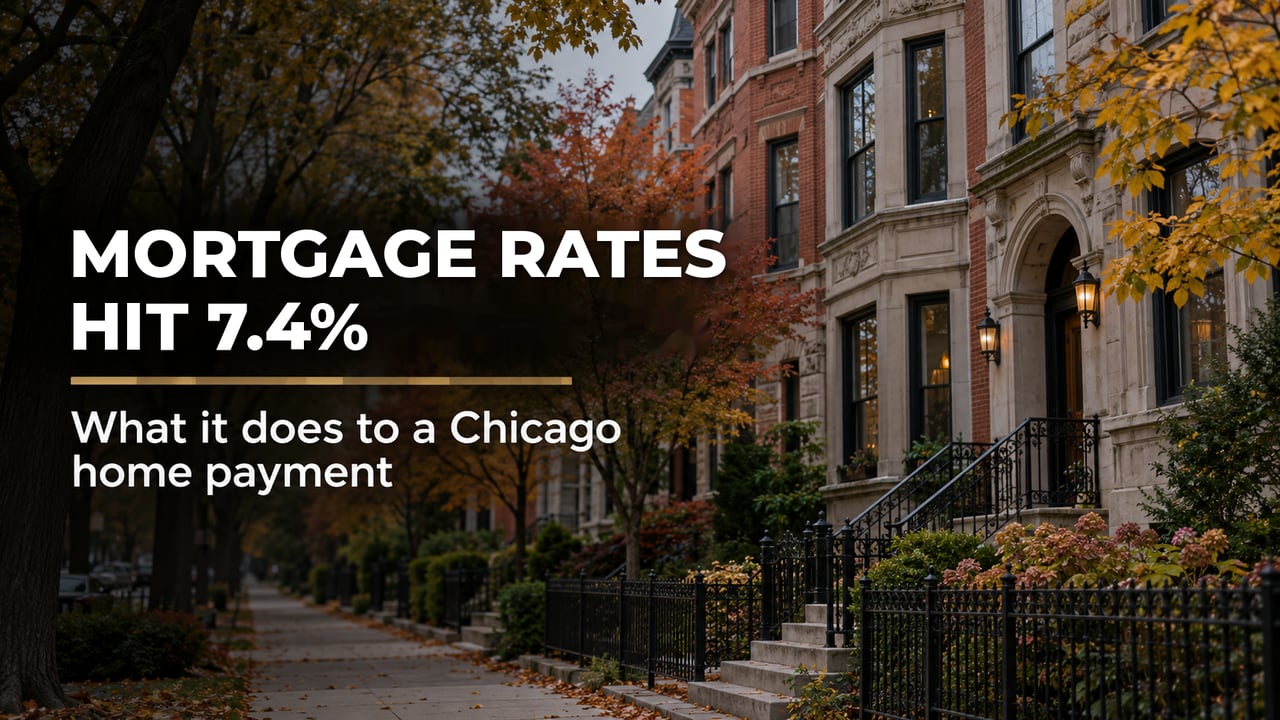
How much does a 7.4% mortgage rate add to a Chicago home payment? On a typical $600,000 North Side home with 20% down, a 7.40% rate puts principal and interest at about $3,323 a month. That is about $352 more per month, or $4,228 more per year, than the same loan cost at last year's 6.30% rate.
Freddie Mac reported that the average 30-year fixed rate reached 7.40% as of October 8, 2026, up from 7.28% the week before. A year earlier, the same rate averaged 6.30%. The 15-year fixed rate rose to 6.73%. Freddie Mac's number is a weekly average. Bankrate's weekly survey put the 30-year fixed at 7.53% on October 8, the highest since November 2023, and its national average was 7.54% on October 12.
National headlines will tell you rates went up. What my buyers want to know is what that means for a condo in Lincoln Square or a house in North Center. In this post, I run the numbers for four Chicago neighborhoods, show you what the monthly number leaves out, and walk through the ways my buyers are bringing the payment down right now.
I used the median condo and townhome price in each neighborhood for January through August 2026, from the Chicago Association of REALTORS®. Each payment assumes 20% down and a 30-year fixed loan, and shows principal and interest only.
Neighborhood (median condo price) | Monthly at 7.40% (Oct 2026) | Monthly at 6.30% (Oct 2025) | Extra Cost Per Year |
|---|---|---|---|
Lincoln Square ($405,000) | $2,243 | $2,005 | $2,854 |
Lakeview ($505,000) | $2,797 | $2,501 | $3,559 |
North Center ($645,000) | $3,573 | $3,194 | $4,545 |
Lincoln Park ($715,000) | $3,960 | $3,541 | $5,039 |
In Lakeview, the higher rate adds about $297 a month to the median condo. In Lincoln Park, it adds about $420.
Here is another way to see it. A buyer whose payment was $2,971 a month on a $600,000 home last year would need a home of about $536,000 to keep that same payment at 7.40%. In a market where many homes are selling over list, that gap changes which homes are realistic, which is why I talk about rate and price together with every buyer.
Principal and interest is only part of what you pay each month in Chicago. Property taxes, homeowners insurance, condo assessments, and mortgage insurance if you put less than 20% down can add hundreds or even thousands of dollars on top. A condo with a $600 monthly assessment and a $7,000 tax bill adds more to your monthly cost than the rate increase in the table above. Assessments matter so much that a lower-priced condo with a high assessment can cost more each month than a higher-priced condo with a low one.
Cook County taxes also catch buyers off guard, because the tax shown on a listing reflects the seller's exemptions, not yours. My guides on Chicago property taxes for buyers and Chicago condo HOA fees show you how to estimate those two numbers before you make an offer.
I covered this question in detail in my post on waiting for mortgage rates to drop in Chicago. The short version is that the right home has to be for sale when you are ready, and Chicago's North Side has had very few homes for sale in 2026. Through August, homes for sale were down from a year earlier in 9 of the 10 neighborhoods I track each month.
If rates fall later, you may be able to refinance, but that is never guaranteed and a refinance has its own closing costs unless your lender offers a free refinance. I would not buy a home you can only afford if rates drop. I would buy a home whose payment works today, and treat a future refinance as a bonus.
If you are deciding when to buy, the time of year matters too. Here is why October is the best month to buy in Chicago, based on five years of Illinois REALTORS data.
Freddie Mac itself reminds borrowers that comparing several rate quotes can save thousands over the life of a loan. Rates and fees can differ from one lender to the next on the same day, for the same buyer. Ask each lender for an official Loan Estimate so you are comparing the same numbers.
A point is an upfront fee equal to 1% of the loan amount that lowers your interest rate. How much one point lowers the rate depends on the lender and the day, so ask for quotes with and without points. Then divide the cost of the points by the monthly savings to see how many months it takes to break even. If you think you will sell or refinance before that point, paying points may not make sense.
More lenders, including some I work with, are now offering a lender-paid temporary buydown. The lender lowers your rate for the first year of the loan, which makes that first year of payments easier, and it does not depend on the seller agreeing to anything. That matters in Chicago, because it can still work when you are competing against other offers.
If rates come down during that first year, you may be able to refinance into a lower rate. If they do not, your rate goes back to the original rate in year two, so make sure that full payment works for you before you buy. Ask your lender how the program affects your rate and fees compared with a regular loan.
When a home is not drawing multiple offers, a seller credit can be worth more to you than the same amount off the price, because it can go toward buying down your rate or paying your closing costs. This only works on homes that are not getting multiple offers, and it is part of how I negotiate for my buyers. Your lender has to approve how the credit is used, so I build it into the offer from the start.
Some buyers compare an adjustable-rate mortgage, which starts with a fixed rate for a set number of years and then can change. It can lower your payment early on, but the payment can rise later, so it only makes sense if you understand the risk and have a plan. Your lender can show you both options side by side.
If the payment is too high in the neighborhood you love, changing the type of home often works better than leaving the area. A two-bedroom condo instead of a three-bedroom, or a vintage building instead of new construction, can lower the price without changing your commute or your street. When I build a buyer's search, I start from the monthly payment they want and work backward to the price.
A strong credit score helps with every one of these options. My guide on what credit score you need to buy a home in Chicago explains why, and my Chicago down payment guide covers how much to put down.
Buyers shop by monthly payment, so when rates rise, some of them lower their price range. That makes your first list price matter even more, because a home priced just above a buyer's payment limit may never show up in their search. If you are thinking of selling this fall or winter, start with a free home value review.
If you already own a condo and want a bigger home, you have something many first-time buyers do not: equity. Rates affect both your next loan and the budgets of the buyers for your current home. That makes the price of your current home, and the order of selling and buying, matter more this fall than they did a year ago.
Here is an example. Say you sell your condo and move up to a $1,000,000 single-family home with $300,000 down. On a $700,000 loan, principal and interest come to about $4,847 a month at 7.40%, compared with about $4,333 at 6.30% a year ago. That is about $514 more per month, or about $6,166 more per year.
Your equity is your biggest lever. Every extra $50,000 you can put down from the sale of your current home lowers that payment by about $346 a month at 7.40%. That makes pricing and preparing your current home correctly one of the most important parts of moving up, because a stronger sale means a smaller loan on the next one. My post on how to price your home to sell in Chicago explains how I set that number.
Many move-up owners are also holding a mortgage rate from a few years ago that is much lower than today's, and giving it up can feel expensive. Look at the full monthly cost of the home you actually need, not just the rate, and compare it with the cost of staying where you are. If you decide to move, my page on selling and buying a home at the same time in Chicago and my post on whether to buy first or sell first walk through how to plan both sides so you are not carrying two homes longer than you need to.
Example payments are principal and interest only on a 30-year fixed loan, using Freddie Mac's average rates for October 8, 2026 (7.40%) and a year earlier (6.30%). Your rate and payment will depend on your lender and loan type.
When you choose an agent, look for numbers you can verify. Here are mine:
You work with me directly from the first call to the closing table, with no handoff to a team member. If you are a first-time buyer, my first-time home buyer page explains how I help you plan your budget before you start touring.
According to Freddie Mac, the average 30-year fixed mortgage rate was 7.40% as of October 8, 2026, and the 15-year fixed rate was 6.73%. Freddie Mac publishes a new average every Thursday, and the rate you are offered depends on your credit, down payment, and loan type.
With 20% down, a $480,000 loan at 7.40% for 30 years costs about $3,323 a month in principal and interest. Property taxes, insurance, and any condo assessment are added on top of that.
On a $480,000 loan, the payment at 7.40% is about $352 more per month than at 6.30%, the average a year earlier. That adds up to about $4,228 per year.
The median Lakeview condo and townhome price for January through August 2026 was $505,000, according to the Chicago Association of REALTORS®. With 20% down at 7.40%, principal and interest come to about $2,797 a month, before taxes and assessments.
Rates are hard to predict, and Chicago's North Side has had fewer homes for sale in 2026 than in 2025. Many buyers choose a home whose payment works at today's rate and consider refinancing later if rates fall, knowing a refinance is not guaranteed and has its own costs.
Often, yes. A seller can agree to a credit at closing that you use to buy down your rate, as long as your loan program allows it. This is only possible on homes that are not getting multiple offers. When several buyers are competing, sellers do not give credits. A lender-paid temporary buydown, which some lenders now offer, is different because it does not depend on the seller, so it can still work when you are competing against other offers.
I am Dee Savic, a Chicago Realtor® with Baird & Warner and a Certified Negotiation Expert. I have more than 24 years of experience, more than 300 closed transactions, over $100 million in career sales, and more than 190 five-star reviews across Google, Zillow, Realtor.com, and FastExpert. You can reach me directly at 773.719.0989.
If you are buying, start with my free Chicago Buyer's Course, or schedule a complimentary and confidential consultation. We will spend about an hour on your budget, the neighborhoods that fit it, and how to make a strong offer at today's rates. You can also call or text me directly at 773.719.0989.
Mortgage rates from the Freddie Mac Primary Mortgage Market Survey, October 8, 2026, and Bankrate's national survey of lenders, October 8 and October 12, 2026. Median prices from the Chicago Association of REALTORS® Local Market Updates, January to August 2026, current as of September 14, 2026; all data from Midwest Real Estate Data LLC. Payments are estimates of principal and interest only, assume 20% down and a 30-year fixed loan, and are not a loan offer. Accurate at the time of research, deemed reliable but not guaranteed.
Dee Savic is a Chicago Realtor® with Baird & Warner, working out of 4553 N. Lincoln Ave. She helps buyers, sellers, and relocation clients across Chicago, including Lakeview, Lincoln Park, Lincoln Square, Ravenswood, North Center, Roscoe Village, Andersonville, Uptown, Bucktown, Wicker Park, and the Gold Coast.

Dee Savic
Realtor® | Baird & Warner
4553 N. Lincoln Ave, Chicago, IL 60625
773.719.0989
[email protected]
deesavic.com
Neighborhood Guides
What homes sold for, the 606, the Blue Line, types of homes, and Bucktown vs. Wicker Park
Buying
Real 2026 sales in Lincoln Park, Lakeview, North Center, Roscoe Village, Lincoln Square, Irving Park, Edgewater, and Andersonville

Buying
Where the unit sits, elevators, pets, wind and sound, views, parking, and building rules

Buying
The real monthly cost, yards, winter, parking, competition, long-term value, and choosing the right neighborhood
Neighborhood Guides
The six parts of 60613, from the lakefront to Damen, and what homes sold for in each in 2026
Neighborhood Guides
Where Buena Park is, what homes sold for in 2026, Hutchinson Street, the lakefront, schools, and safety
Buying
Five years of Chicago prices, where you can and cannot negotiate, and how to handle a 7.40% mortgage rate

Local Events
Dates, times, and exact blocks for Halloween events in Lakeview, Lincoln Park, Lincoln Square, Ravenswood, North Center, Andersonville, and Edgewater
Neighborhood News
The Camry Lot expansion, the 2027 All-Star Game, parking rules, and what homes nearby sold for in 2026
I'm Dee Savic, your trusted Chicago real estate expert, and I'm here to guide you through your relocation journey. Discover why Chicago is the perfect city for you; from its diverse neighborhoods to its cultural vibrancy, Chicago offers an unmatched urban experience. Together, we'll find a community and home that fits your lifestyle and aspirations.