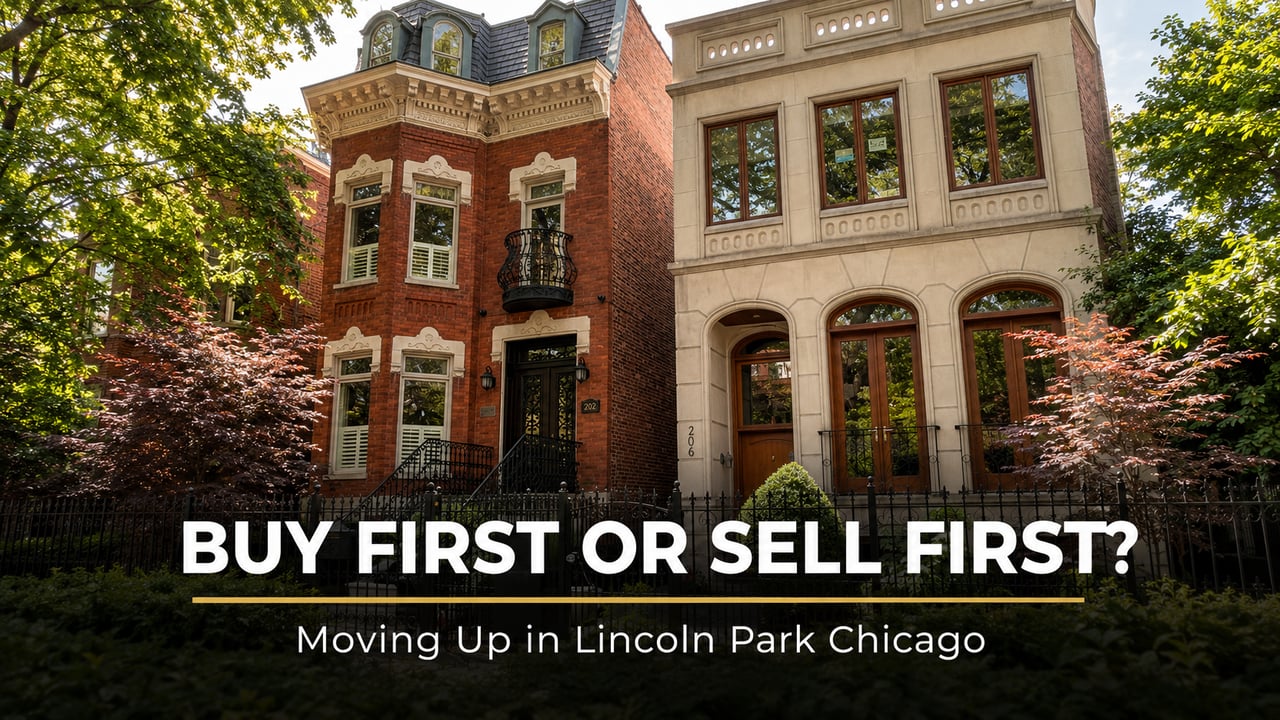
Should you buy first or sell first when moving up to a larger home in Lincoln Park Chicago? For most Chicago move-up buyers, selling first is the safer path because it gives you a clear budget, unlocks your equity, and helps you write a stronger offer without a home sale contingency. But buying first can make sense if you have enough cash, strong equity, bridge financing, or the ability to comfortably qualify for both homes at the same time.
If you own a condo or smaller home in Chicago and want to move into a larger place in Lincoln Park, the order of your sale and purchase matters. Done well, the transition can feel organized and manageable. Done without a plan, you can end up carrying two mortgages, rushing into the wrong home, or losing the one you really wanted because your offer was too complicated.
I have been helping Chicago buyers and sellers navigate these move-up decisions for 24 years. The right answer is not the same for everyone. It depends on your equity, financing, comfort with risk, timing, and how competitive your target home is likely to be.
If you need the proceeds from your current home to buy the next one, selling first is usually the cleaner and safer strategy.
If you can buy without selling first, and you are financially comfortable carrying both homes for a short period, buying first can give you more control over the move.
And if neither option feels ideal, there are bridge strategies that can help, including rent-backs, longer closings, bridge loans, HELOCs, and carefully timed listing plans.
The goal is not just to buy the next home. The goal is to protect your money, your negotiating power, and your peace of mind while you do it.
Lincoln Park is not an easy neighborhood to “wing it” in. Prices vary dramatically by property type, and the jump from a condo to a larger home can be significant.
Recent market data shows why planning matters. In April 2026, Lincoln Park condos and townhomes had a median sale price of $757,000 and received 105.7% of original list price on average, according to the Chicago Association of REALTORS Local Market Update. Market time was 22 days, and inventory was down 43% year over year.
On the larger-home side, the MLS data I reviewed showed 54 recently closed Lincoln Park properties with an average sold price of about $2.55 million. The average sale-to-final-list-price ratio was 100.24%.
That is the move-up challenge in plain English: your current home may sell well, but the larger Lincoln Park home you want may also be expensive and competitive. That is why the order of operations matters.
Selling first means you list and sell your current home before you close on the next one. For many Chicago move-up buyers, this is the most financially responsible path.
You know your real budget. Once your current home is under contract or sold, you know how much equity you actually have to work with. That makes the next purchase much easier to plan.
Your offer is stronger. In a competitive Lincoln Park market, sellers usually prefer clean offers. If your offer is not dependent on selling your current home, it is much more attractive.
You avoid carrying two mortgages. With today’s mortgage rates, taxes, insurance, and assessments, carrying two properties can get expensive quickly. Selling first reduces that pressure.
You have more confidence when negotiating. When you know your numbers, you can make clearer decisions about price, inspection, appraisal risk, and timing.
The biggest concern is obvious: where do you live if your current home sells before you find the next one?
That is a real concern, but it does not automatically mean selling first is a bad idea. It means we need a plan before the listing goes live. Depending on your situation, that plan may include negotiating a rent-back, asking for a longer closing, arranging short-term housing, or starting your search before your home officially hits the market.
For many move-up buyers, the stress of possibly moving twice is still less risky than buying first and hoping the current home sells quickly enough to make the numbers work.
Buying first means you purchase the next home before selling your current one. This can be appealing because it gives you a place to move into and avoids the uncertainty of temporary housing.
But it only works when the finances are strong enough.
You can qualify for both homes. Your lender needs to be comfortable with your current mortgage, the new mortgage, taxes, insurance, and any HOA assessments.
You have enough cash for the down payment. If your down payment is tied up in your current home, buying first may not be realistic without a bridge loan, HELOC, or other financing strategy.
You have strong reserves. Most buyers underestimate how uncomfortable it can feel to carry two properties, even for a short period. You want enough cushion that you are not forced into a bad decision.
Your current home is likely to sell quickly. If your current home is in a strong segment, priced correctly, and prepared well, buying first may be less risky. But you still need to be honest about pricing.
The risk is not just financial. It is emotional.
If you buy first and your current home does not sell as quickly as expected, you may feel pressure to reduce the price, accept weaker terms, or make decisions from a place of stress. That can cost more than people expect.
Buying first can absolutely work, but it should never be based on “I’m sure my place will sell.” It should be based on lender approval, realistic pricing, actual market data, and a backup plan if things take longer than expected.
For many move-up buyers, the best answer is not strictly buy first or sell first. It is a bridge strategy that gives you more flexibility.
A rent-back allows you to sell your current home and stay in it for a short period after closing. This can give you time to find or close on your next home without moving immediately.
In a strong seller’s market, buyers may be willing to offer this flexibility, especially if your home is desirable and well-priced.
Another option is to negotiate a longer closing on your sale, giving you more time to secure the next home. This can work well if your buyer has flexibility and your next purchase is already in motion.
A bridge loan or home equity line of credit may allow you to access equity before your current home sells. These tools are not right for everyone, and they need to be discussed with a lender early.
The advantage is flexibility. The trade-off is cost and qualification. You need to understand the payment, fees, timeline, and risk before using one.
Sometimes the best bridge strategy is simply preparation. You do the repairs, decluttering, painting, staging, photography planning, and pricing work before you start seriously shopping. That way, if the right Lincoln Park home appears, your current home can hit the market quickly.
When I talk through this with a move-up buyer, I do not start with a generic answer. I start with the numbers.
We look at:
Once we know those answers, the right strategy becomes much clearer.
For some clients, selling first is the obvious choice. For others, buying first is realistic and gives them more comfort. And for many, the best plan is a carefully timed hybrid.
This is one of the most common move-up scenarios I see.
You may own a condo, have built solid equity, and now want more space, outdoor space, a better layout, or a single-family home. The challenge is that the larger-home market in Lincoln Park is a very different price tier from the condo market.
That does not mean the move is impossible. It means you need to understand the gap before you start touring homes.
If your condo sells well, that equity may become the down payment for the next home. But if the larger home you want is moving quickly, you may not have the luxury of figuring out your sale strategy after you find it. You need the plan first.
In a competitive Lincoln Park situation, a home sale contingency will weaken your offer.
From the seller’s perspective, a home sale contingency adds uncertainty. They are not just evaluating you. They are also depending on your home selling successfully, your buyer performing, and your closing happening on time.
That does not mean a contingent offer can never work. It depends on the home, the price point, the competition, and how strong your current listing position is. If a home you are bidding on has multiple offers, an offer with a house sale or closing contingency won't be looked at favorably. So if you can avoid making your purchase dependent on your sale, your offer is stronger.
For most Chicago move-up buyers, I would start by planning as if you are going to sell first, then see whether your finances allow a more flexible option.
That means getting your current home valued, talking to a lender, understanding your likely proceeds, and preparing your home before you are emotionally attached to the next one.
If the numbers show that buying first is realistic, great. Then we can talk about whether that gives you a better lifestyle outcome.
If the numbers show that selling first is safer, we can build the timeline around that and reduce the risk of being caught between homes.
The biggest mistake is not choosing the “wrong” path. The biggest mistake is choosing without understanding the numbers first.
If you are moving up and wondering how far your budget will go, my post on what $1 million buys on the North Side compares real 2026 sales in Lincoln Park and six other neighborhoods.
For most move-up buyers, selling first is safer because it gives you a clear budget and a stronger purchase position. Buying first can work if you have enough cash, equity, reserves, or bridge financing to carry both homes comfortably.
Yes, but only if your lender approves you to carry both properties or if you have another way to access the down payment. Before assuming you can buy first, talk to your lender and run the numbers carefully.
You can, but it may make your offer less competitive. In Lincoln Park, sellers often prefer cleaner offers, especially when a home is well-priced and attracting strong interest.
A rent-back allows the seller to remain in the home for a short period after closing. For move-up buyers, this can create breathing room between selling the current home and closing on the next one.
A bridge loan is short-term financing that can help you buy your next home before selling your current one. It can be useful, but it also comes with costs and qualification requirements, so it should be reviewed carefully with a lender.
Not always, but you should at least prepare before you shop seriously. That means knowing your home’s value, likely net proceeds, timing, and what needs to be done before listing.
The biggest mistake is falling in love with the next home before understanding the sale strategy for the current one. In a competitive market, timing and financing need to be clear before you make a move.
No. The same buy-first-or-sell-first decision applies across Chicago, especially in competitive North Side neighborhoods. But Lincoln Park makes the decision more important because the price jump from a condo or smaller home to a larger home can be significant.
If you are trying to decide whether to buy first or sell first, I can help you look at both sides of the move before you make a decision.
We can review your current home value, likely proceeds, timing, financing, and what your next home may realistically cost. From there, we can build a plan that makes sense for your numbers and your life.
Start with a free home value review, or schedule a complimentary and confidential consultation here.
For more on Lincoln Park as a neighborhood, see my Lincoln Park neighborhood guide.
Data source: Midwest Real Estate Data LLC, MRED MLS, and Chicago Association of REALTORS Local Market Update for Lincoln Park. MLS data reviewed June 2026. Data is deemed reliable but not guaranteed. The Chicago Association of REALTORS report categorizes condos and townhomes as attached single-family.
Dee Savic
Realtor® | Baird & Warner
4553 N. Lincoln Ave, Chicago, IL 60625
773.719.0989
[email protected]
deesavic.com
Neighborhood Guides
What homes sold for, the 606, the Blue Line, types of homes, and Bucktown vs. Wicker Park
Buying
Real 2026 sales in Lincoln Park, Lakeview, North Center, Roscoe Village, Lincoln Square, Irving Park, Edgewater, and Andersonville

Buying
Where the unit sits, elevators, pets, wind and sound, views, parking, and building rules
Buying
The real monthly cost, yards, winter, parking, competition, long-term value, and choosing the right neighborhood
Neighborhood Guides
The six parts of 60613, from the lakefront to Damen, and what homes sold for in each in 2026
Neighborhood Guides
Where Buena Park is, what homes sold for in 2026, Hutchinson Street, the lakefront, schools, and safety

Buying
Five years of Chicago prices, where you can and cannot negotiate, and how to handle a 7.40% mortgage rate

Local Events
Dates, times, and exact blocks for Halloween events in Lakeview, Lincoln Park, Lincoln Square, Ravenswood, North Center, Andersonville, and Edgewater
Neighborhood News
The Camry Lot expansion, the 2027 All-Star Game, parking rules, and what homes nearby sold for in 2026
I'm Dee Savic, your trusted Chicago real estate expert, and I'm here to guide you through your relocation journey. Discover why Chicago is the perfect city for you; from its diverse neighborhoods to its cultural vibrancy, Chicago offers an unmatched urban experience. Together, we'll find a community and home that fits your lifestyle and aspirations.