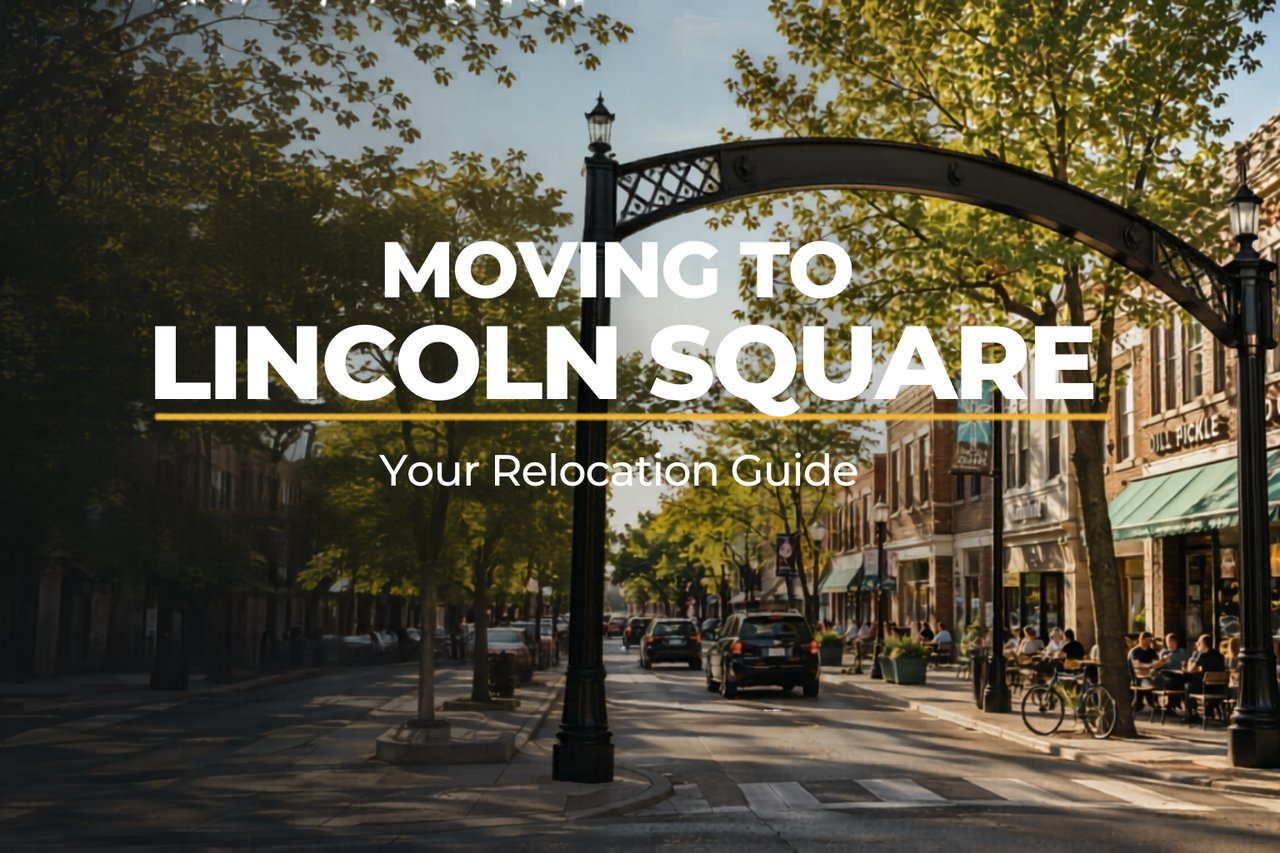
What do out-of-state buyers need to know before moving to Lincoln Square, Chicago? Relocating to Lincoln Square from another state means navigating Chicago-specific real estate laws, a competitive low-inventory market, permit parking, Cook County property taxes, and winters that genuinely affect how you should evaluate a home. Going in prepared makes the difference between a smooth move and an expensive surprise.
I work with relocating professionals every week. Most of them are smart, organized, and well-prepared in every other area of their lives. And almost all of them hit the same handful of surprises when they start seriously pursuing a home in Lincoln Square. This post is the honest briefing I give buyers before they get on a plane to start touring.
If you are still deciding whether Lincoln Square is the right neighborhood for you, start with my complete Lincoln Square neighborhood guide. This post assumes you are already interested and want to know what comes next.
Illinois is an attorney state, which means a licensed real estate attorney must be involved in your closing. This is not optional and it is not just a formality — your attorney reviews the contract, handles title, and protects your interests through the transaction. If you are coming from a state where a title company handles everything, this will feel different. Budget for it: attorney fees typically run $500 to $1,000 for a standard residential closing in Chicago.
Chicago real estate contracts move quickly compared to many other markets. Once an offer is accepted, attorney review typically happens within five business days. Inspections follow immediately after. If you are coordinating from another state, you need to be available, responsive, and have your team lined up before you make an offer — not after. Buyers who are slow to respond during attorney review can lose deals they thought were locked up.
This is the single most common financial surprise for out-of-state buyers in Chicago. Cook County property taxes are among the higher in the country relative to home values, and they vary significantly street by street depending on the tax PIN and any exemptions the current owner holds. Always ask your agent to pull the current tax bill and factor that into your monthly payment calculation. The number on the listing is often based on the seller's exemptions and will change when ownership transfers to you. The Cook County Assessor's website lets you look up any property's current assessed value and tax history.
Buyers from warmer climates consistently underestimate how much Chicago winters should factor into their home evaluation. This is not about discouraging you — it is about making sure you are looking at the right things.
In Lincoln Square's vintage housing stock — greystones, bungalows, Victorian-era homes — heating systems vary widely. Forced air, radiator heat, boilers, and in-floor radiant are all common. Some are efficient and updated. Some are aging and expensive to run. Always ask about the age and type of the heating system during your inspection. A home without central air is also a harder sell when you go to resell, and Chicago summers are genuinely hot — this is not a nice-to-have for most buyers.
Out-of-state buyers often treat garage parking as a preference rather than a necessity. In Chicago, where winter means scraping ice at 7am and parallel parking on snow-narrowed streets, garage parking is a quality-of-life issue. Homes with garage parking command a premium in Lincoln Square for a reason. If you are evaluating a home without a garage, walk that street in your mind on a February morning and decide if you are genuinely comfortable with the trade-off.
Many of Lincoln Square's vintage condo buildings have shared laundry in the basement rather than in-unit hookups. For buyers coming from markets where in-unit laundry is standard, this is a consistent adjustment. It affects both daily convenience and long-term resale value. If in-unit laundry is important to you, make it a non-negotiable in your search criteria rather than something you plan to add later — not all buildings permit the retrofit.
Most residential streets in Lincoln Square are permit parking zones, which means you need a city-issued residential parking permit to park on the street overnight. Permits are tied to your address and are easy to obtain once you are a resident — but if you have visitors or a second car, street parking logistics require some thought. This is a daily reality of Chicago neighborhood life that buyers from suburban or car-centric markets find takes adjustment.
Lincoln Square is served by the Brown Line L, with stations at Western and Rockwell. The Brown Line is elevated through this stretch, which means homes on or near the tracks get train noise. Some buyers genuinely do not mind it — many Chicagoans tune it out entirely within weeks. Others find it disruptive. The honest advice: walk the specific block you are considering at different times of day, including during rush hour, before you commit. A home three blocks from the tracks and a home one block from the tracks are different living experiences.
Chicago's North Side is currently running at roughly 1.5 months of housing supply. NAR considers 4 to 6 months a balanced market. What that means for out-of-state buyers: you cannot afford to browse casually and schedule a trip when something looks interesting. By the time you land, the home is gone. Buyers who succeed in this market from out of state do their neighborhood homework in advance, get fully pre-approved before they start looking, and are ready to move when they see the right property — sometimes making competitive offers before they have physically seen the home.
A good buyer's agent in Lincoln Square should be doing FaceTime or video walkthroughs for out-of-state clients on any property worth serious consideration. I do this regularly. You can evaluate layout, condition, natural light, and street feel remotely well enough to make an informed decision — as long as your agent knows what to show you and what questions to ask on your behalf.
Even in a competitive market, do not waive your inspection on a vintage Chicago property. Chicago's older housing stock has specific issues — knob-and-tube wiring in unrenovated buildings, aging brick and tuckpointing, older plumbing systems — that a qualified inspector will flag. In competitive situations, buyers sometimes shorten the inspection timeline rather than waiving it entirely. That is a reasonable compromise. Waiving it altogether on a 100-year-old greystone is not. Dee Savic Home Inspection Guide is a good primer if this process is new to you.
Most out-of-state buyers arrive with a list of two or three neighborhoods they have researched online. Lincoln Square is often on that list alongside Lakeview, Lincoln Park, and Andersonville. Here is the honest comparison:
vs. Lakeview and Lincoln Park: Both are denser, closer to the lakefront, and more expensive per square foot. Lincoln Square offers more architectural character and more space for the money. The trade-off is distance from the lake and a slightly less frenetic pace.
vs. Andersonville: Andersonville is Lincoln Square's neighbor to the northeast and shares a similar independent, community-rooted character. Andersonville skews slightly younger and denser along Clark Street. The neighborhoods overlap enough that buyers often consider both together.
vs. Roscoe Village and North Center: Both are strong North Side neighborhoods with their own distinct character. Roscoe Village has a lively commercial strip along Roscoe Street with restaurants, cafes, bars, and bookstores that rivals anything on the North Side. North Center skews slightly more residential and family-oriented. Both offer strong value and easy access to the same Brown Line transit corridor as Lincoln Square. The choice between them often comes down to specific block feel and price point rather than lifestyle trade-offs.
My North Side neighborhood guide covers all of these in detail if you are still narrowing down your options.
The out-of-state buyers who make the smoothest transitions to Lincoln Square are the ones who do this before they get on a plane:
Yes. Lincoln Square is one of the most welcoming and community-oriented neighborhoods on Chicago's North Side, and it consistently attracts relocating professionals who want a genuine neighborhood feel with good transit access to downtown. The learning curve is manageable with the right preparation and the right local agent.
Very competitive right now. Chicago's North Side has roughly 1.5 months of housing supply, well below a balanced market. Out-of-state buyers who arrive without a pre-approval and a clear strategy are at a real disadvantage against local buyers who can move immediately. Preparation before you visit is not optional in this market.
Ideally yes, at least once. That said, many out-of-state buyers in today's market make offers based on video walkthroughs and then visit for the inspection. The key is having a buyer's agent you trust completely to represent your interests on the ground. I work with relocating buyers this way regularly and the process works when the preparation is solid.
Whether your move is 6 weeks away or 6 months out, the earlier we talk the better positioned you will be when you are ready to act. I specialize in helping busy professionals relocate to Chicago and I have built a process specifically for out-of-state buyers that covers everything from neighborhood selection through closing day.
Reach out to schedule a complimentary and confidential relocation consultation. We can cover your timeline, your priorities, what Lincoln Square looks like for your specific budget, and what you need to have in place before your search begins.
Dee Savic
Realtor® | Baird & Warner
773.719.0989
[email protected]
deesavic.com
Neighborhood Guides
What homes sold for, the 606, the Blue Line, types of homes, and Bucktown vs. Wicker Park
Buying
Real 2026 sales in Lincoln Park, Lakeview, North Center, Roscoe Village, Lincoln Square, Irving Park, Edgewater, and Andersonville

Buying
Where the unit sits, elevators, pets, wind and sound, views, parking, and building rules

Buying
The real monthly cost, yards, winter, parking, competition, long-term value, and choosing the right neighborhood
Neighborhood Guides
The six parts of 60613, from the lakefront to Damen, and what homes sold for in each in 2026
Neighborhood Guides
Where Buena Park is, what homes sold for in 2026, Hutchinson Street, the lakefront, schools, and safety

Buying
Five years of Chicago prices, where you can and cannot negotiate, and how to handle a 7.40% mortgage rate

Local Events
Dates, times, and exact blocks for Halloween events in Lakeview, Lincoln Park, Lincoln Square, Ravenswood, North Center, Andersonville, and Edgewater
Neighborhood News
The Camry Lot expansion, the 2027 All-Star Game, parking rules, and what homes nearby sold for in 2026
I'm Dee Savic, your trusted Chicago real estate expert, and I'm here to guide you through your relocation journey. Discover why Chicago is the perfect city for you; from its diverse neighborhoods to its cultural vibrancy, Chicago offers an unmatched urban experience. Together, we'll find a community and home that fits your lifestyle and aspirations.