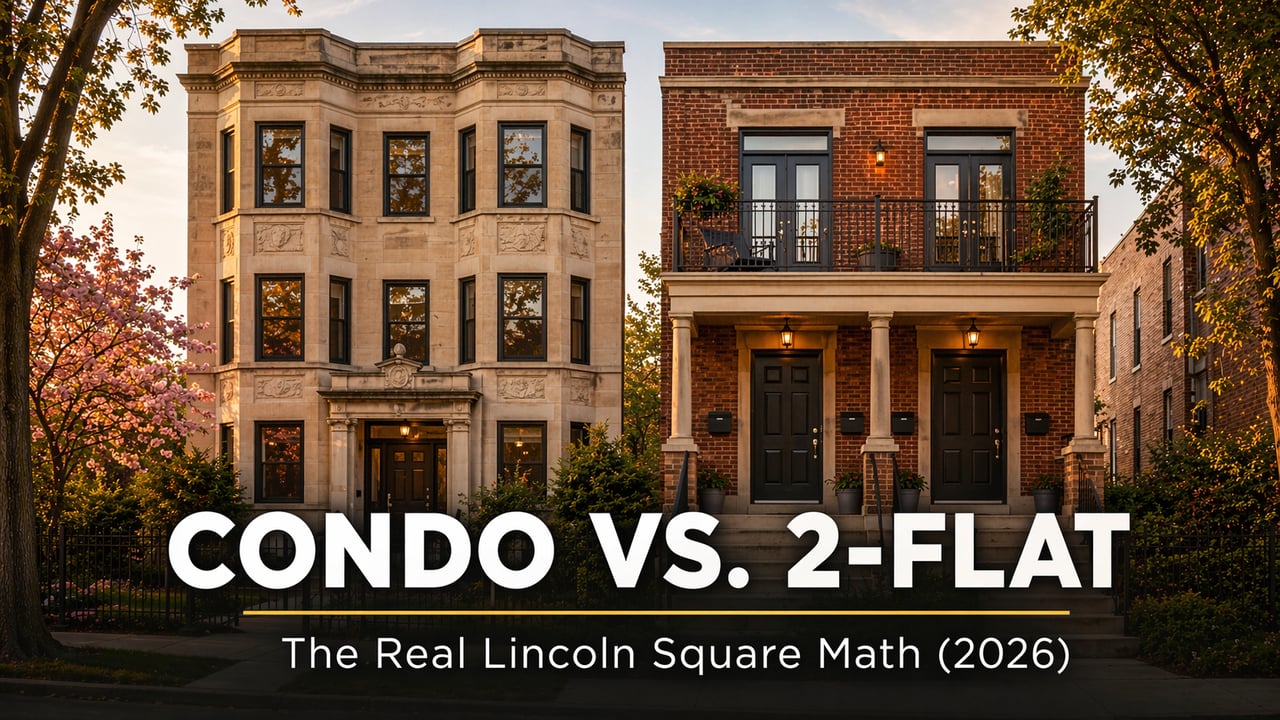
Is a $600,000 condo or a $900,000 2-flat the smarter buy in Lincoln Square in 2026? A $600,000 Lincoln Square condo costs roughly $4,400 per month all-in. A $900,000 Lincoln Square 2-flat with a tenant in the second unit costs roughly $3,150 per month net — meaning you can own a $300,000 larger asset for about $1,250 per month less, while building substantially more equity over five years. The 2-flat wins on cash flow and on long-term wealth.
Most buyers shopping Lincoln Square assume the condo is the smaller, safer move. It is the path of least resistance — lower price, less responsibility, no tenants. But when you actually sit down and run the numbers using current 2026 rates, current Lincoln Square taxes and HOA assessments, and a real 2-flat that just closed in the neighborhood, the picture changes.
This post does the math. Real numbers. A real recent Lincoln Square 2-flat sale as the anchor. No pro forma fantasy.
If you are still getting oriented on Lincoln Square ownership types in general, start with my breakdown of whether Lincoln Square is a good investment in 2026. This post picks up where those leave off and zooms in on the head-to-head math between the two paths most buyers actually weigh.
Before any math works, the math needs to be real. The 2-flat in this comparison is not hypothetical — it is 2625 W Leland Avenue, a Lincoln Square 2-flat that closed on April 15, 2026 at $899,000. The building was sold with both units leased and existing rents in place: $3,350 per month in the larger unit and $2,300 per month in the smaller unit, for $5,650 per month in gross rental income.
That matters for two reasons. First, when you finance an owner-occupant 2-flat purchase, your lender will use a portion of the existing rent to offset your monthly housing payment in your debt-to-income calculation — so an in-place lease at $3,350 actually helps you qualify for the loan. Second, it removes the guesswork from any "what could it rent for" debate. The market has already answered.
For this comparison, we are going to assume an owner-occupant buyer who moves into the larger unit (the one currently renting at $3,350) and either keeps the existing tenant in the smaller unit or re-leases it at the in-place rent. So the buyer occupies the $3,350 unit and collects $2,300 per month from the tenant. We will round the assumed price to $900,000 for clean math.
The condo side of the comparison: a representative $600,000 Lincoln Square 2-bedroom vintage condo, which is squarely in the meat of what is selling in 2026 in renovated vintage buildings near the Brown Line.
All numbers below assume a 30-year fixed mortgage at 6.75% interest — roughly the prevailing rate in early 2026 per the Freddie Mac Primary Mortgage Market Survey. Property taxes use Lincoln Square effective tax rate assumptions per Cook County Assessor data. Insurance and assessment numbers reflect typical Lincoln Square 2026 ranges. Confirm specifics with your lender, your insurance agent, and the actual building.
| Line Item | Monthly Cost |
|---|---|
| Down payment | $120,000 (one-time) |
| Loan amount | $480,000 |
| Principal & interest @ 6.75% | ~$3,113 |
| Property tax (~1.6% effective) | ~$800 |
| Insurance (HO-6 condo policy) | ~$50 |
| HOA assessment (typical vintage 2BR) | ~$450 |
| Total monthly cost | ~$4,413 |
That is your full out-of-pocket monthly housing cost. Nothing comes back. Whatever maintenance the HOA does not cover is on you, and any future special assessment is on you.
| Line Item | Monthly Cost |
|---|---|
| Down payment | $135,000 (one-time) |
| Loan amount | $765,000 |
| Principal & interest @ 6.75% | ~$4,962 |
| Property tax (~1.7% effective on 2-unit) | ~$1,275 |
| Insurance (dwelling policy, multi-unit) | ~$150 |
| Water / sewer (often paid by owner) | ~$80 |
| Scavenger / refuse | ~$30 |
| Gross monthly cost | ~$6,497 |
| Less: rental income from tenant unit (Leland in-place) | – $3,350 |
| Net monthly cost (owner pays) | ~$3,147 |
Read the bottom line again. A $900,000 Lincoln Square 2-flat costs the owner-occupant buyer roughly $3,147 per month net — about $1,266 per month less than the $600,000 condo, while the buyer is owning a $300,000 larger asset.
If you would rather underwrite to a more conservative rent — say $3,000 per month, which is below the in-place Leland rent and still defensible against current Lincoln Square 2-bedroom rental comps — the net monthly cost rises to about $3,497. Still cheaper than the condo. Still owning a bigger asset.
The reason the math above is even possible is the financing structure that small multi-unit buildings unlock. If you plan to live in one of the units, lenders treat the loan as owner-occupant — not investor — financing. That changes everything about the down payment, the rate, and the qualifying math.
The three main owner-occupant paths on a Lincoln Square 2-flat:
All three paths let the lender count a portion of the existing or projected rental income from the tenant unit toward your qualifying income. That means the same paycheck qualifies for substantially more building when you go the 2-flat route. Underwriting rules and rent-credit percentages vary by loan product, so confirm specifics with your lender — but the structural advantage is real and it is the reason 2-flats are one of the most capital-efficient ways to enter Chicago real estate ownership.
Here is the caveat most buyers never hear about — and the reason I lead with the 15%-down math in the monthly cost section above instead of the 5%-down number. The 5%-down Fannie Mae program, and most conventional owner-occupant financing on 2-to-4 unit buildings, requires every living unit in the building to be legal and conforming. That means zoned for, permitted by, and on file with the City of Chicago as a dwelling unit.
A large share of older Chicago 2-flats and 3-flats have a finished basement apartment — kitchen, bathroom, separate entrance — that was built without permits and is technically non-conforming. Sometimes it shows up in MLS as "2-flat plus additional living space" or "3-flat with in-law." Sometimes the listing is silent and the basement unit is only disclosed at showing. Either way, it is a known Chicago quirk.
This matters at appraisal. The appraiser is trained to flag a non-conforming unit, and when they spot a full kitchen in a basement that is not on the permit record, the lender typically requires one of two things:
I have lived this. I had a Lincoln Square 2-flat under contract on the 5%-down program shortly after it rolled out. My buyer was approved, the inspection went well, and we were on the glidepath to close. The appraiser went into the basement, spotted the full kitchen, and requested the entire kitchen be pulled out before closing. The seller, predictably, was not going to demolish a finished kitchen in their own building in the middle of a sale. That buyer really wanted the building, so we pivoted to 15%-down conventional, came up with the additional cash, and closed. The 5%-down path was dead the moment the appraiser walked downstairs.
The takeaway: the 5%-down Fannie Mae program is real, it is powerful, and it can cut your down payment by two-thirds — but only on buildings where every unit is legal. Before you underwrite a Chicago 2-flat at 5% down, ask your agent and your lender to verify:
A good Chicago 2-to-4 unit agent will check this before you write the offer. A great one will know which buildings on the market are eligible for the 5%-down path and which are not — and will tell you up front so you do not end up scrambling for extra cash at closing.
Monthly cost is one piece. Equity build-up is the other piece. To make the comparison conservative, both scenarios below assume the same 3.5% annual appreciation rate — no special bonus for the multi-unit. Lincoln Square has historically delivered well above this rate, but holding the rate equal removes any "of course you picked a higher number for the 2-flat" objection. The math still works.
| Year 5 Snapshot | $600K Condo | $900K 2-Flat |
|---|---|---|
| Original purchase price | $600,000 | $900,000 |
| Estimated value @ 3.5%/yr after 5 years | ~$712,612 | ~$1,068,918 |
| Appreciation gain | ~$112,612 | ~$168,918 |
| Principal paid down (5 years) | ~$29,397 | ~$46,851 |
| Down payment retained as equity | $120,000 | $135,000 |
| Total equity at year 5 | ~$262,000 | ~$350,800 |
| Monthly cash advantage vs. the other scenario (5 yrs × $1,266/mo) | — | +$75,990 in cash retained |
| Less: extra down payment required on 2-flat | — | – $15,000 |
| Total wealth advantage at year 5 | baseline | ~$150,000 ahead of the condo |
Read that bottom row again. Even using identical appreciation assumptions, even after subtracting the extra $15,000 the 2-flat buyer had to put down, the 2-flat path puts the buyer roughly $150,000 ahead of the condo path after five years — about $89,000 in extra equity plus about $76,000 in retained monthly cash that did not have to go toward housing, minus the $15,000 larger down payment. That is a real, hard-dollar gap, not a marketing line.
And we have not assumed rental rate growth, tenant unit re-leasing at higher market rents, principal acceleration, or the historical multi-family appreciation premium. Layer any of those on and the gap widens.
To be fair to the condo: the math above is not the whole story. The condo buyer is buying simplicity, lower up-front cash, and zero landlord responsibility. Those things have real value, and for some buyers they are the right answer. Specifically, a Lincoln Square condo is the better call if:
If any of those describe you, the condo is the right call — full stop. The math in the prior section is not a reason to change that. But for the buyer who has the down payment, the willingness to own a building, and the time horizon to let appreciation and rental income compound, the 2-flat is meaningfully ahead.
The 2-flat is not free money. The buyer who chooses this path is taking on real responsibilities the condo buyer is not, and you should walk in with eyes open:
None of these are dealbreakers. They are the price of admission for the math to work. Buyers who go in expecting them tend to do well. Buyers who treat a 2-flat like a bigger condo do not.
You can still get the 2-flat math without dealing with the day-to-day. A Chicago property manager handles leasing, maintenance dispatch, and rent collection for roughly 6–10% of gross rent. On a $2,300 tenant unit, that is $138–$230 per month — a haircut on the rent, not a dealbreaker on the math.
For owner-occupants who want to "test" being a landlord before scaling, owning the 2-flat you live in is the lowest-risk way to do it. You are next door. You see issues immediately. And if you decide it is not for you in two years, you have two clean exit paths: convert your unit-side to a rental and move out (full investor cash flow), or sell to the next owner-occupant or investor at what is by then an appreciated price.
One reason 2-flats hold value well in Lincoln Square: they sell to three different buyer pools, each of which values the same building differently:
That breadth of demand is part of why Lincoln Square 2-flats have historically held their value through soft market periods better than single-purpose investor buildings in less established neighborhoods. When you are eventually the seller, you are listing into three buyer pools, not one.
| Factor | $600K Condo | $900K 2-Flat |
|---|---|---|
| Down payment (cash needed) | $120,000 (20%) | $135,000 (15% conv.) or ~$22,400 (FHA, on smaller buildings) |
| Loan size | $480,000 | $765,000 |
| Total monthly cost (out of pocket) | ~$4,413 | ~$3,147 net (after $3,350 tenant rent) |
| Asset value owned | $600,000 | $900,000 |
| Year-5 estimated equity | ~$262,000 | ~$350,800 |
| 5-year cash advantage vs. the other | — | ~$76,000 retained cash |
| Total 5-year wealth advantage (net of extra down) | baseline | ~$150,000 ahead |
| Landlord responsibilities | None | Yes — or hire a manager (~6–10% of rent) |
| Maintenance scope | HOA covers exterior | Full building — roof, mechanicals, exterior |
| Special assessment risk | Yes — building-wide | Not applicable |
| Resale buyer pool | Owner-occupants only | Owner-occupants, investors, deconversion buyers |
If your priority is simplicity, low cash up-front, no landlord exposure, and a smaller building footprint — the $600,000 Lincoln Square condo is the right move. Just do the homework on the building's reserves and assessment history before you sign.
If your priority is long-term wealth, lower net monthly cost, and a building that grows with the neighborhood — the $900,000 Lincoln Square 2-flat is the meaningfully better financial outcome, even with identical appreciation assumptions, even after building in maintenance reserves, even with property management baked in. You buy a bigger asset, the tenant pays a chunk of the mortgage, the asset compounds on a larger base, and your buyer pool at exit is three times wider.
The 2-flat path is not for every buyer. But for the buyer it fits, it is one of the most capital-efficient real estate moves available in Chicago in 2026. Most out-of-state buyers never even get this option presented to them. Now you have.
You can search current Lincoln Square homes for sale across all property types right now. If you want a deeper look at how Lincoln Square is performing as a long-term hold, my Lincoln Square investment analysis covers appreciation, rental demand, and the longer-horizon thesis.
With Lincoln Square inventory tight in 2026, your property may be worth meaningfully more than you think — especially a 2-flat, where your buyer pool includes investors, owner-occupant house-hackers, and long-term deconversion buyers, all valuing the same building differently. Get a free, no-obligation Lincoln Square home or 2-flat valuation. Two minutes, no commitment, just the number.
For an owner-occupant who lives in one unit and rents the other, a Lincoln Square 2-flat is typically cheaper per month than a condo of comparable quality, even though the 2-flat has a higher purchase price. In a 2026 example using a $600,000 condo at 20% down versus a $900,000 2-flat at 15% down with $3,350 per month in tenant rent (the actual in-place rent at 2625 W Leland Avenue, which closed at $899,000 on April 15, 2026), the condo runs about $4,400 per month all-in and the 2-flat runs about $3,150 per month net. The 2-flat owner pays roughly $1,250 per month less while owning a $300,000 larger asset.
An owner-occupant buyer using a conventional loan typically puts 15% down on a 2-unit property — $135,000 on a $900,000 2-flat. FHA owner-occupant financing allows as little as 3.5% down up to the Cook County FHA loan limit (approximately $640,000 for a 2-unit in 2026). Investor financing on the same building generally requires 20–25% down and carries a higher interest rate. Confirm current loan limits and your specific qualifying scenario with your lender.
Individual units in Lincoln Square 2-flats and 3-flats typically rent for approximately $2,000 to $3,500 per month depending on size, finish, and parking. Renovated two-bedroom units generally run $2,500–$2,800 in 2026, and larger or higher-finish units push higher — the recently sold 2625 W Leland Avenue 2-flat had in-place rents of $3,350 and $2,300 per unit. Confirm current rental comps with your agent before underwriting a specific building.
Historically, well-maintained Lincoln Square 2-flats have appreciated at or above the rate of comparable condos, in part because the buyer pool at resale is broader — investors, owner-occupant house-hackers, and long-term deconversion buyers all value the same building. The math in this post uses an identical appreciation rate for both scenarios to remove any debate, and the 2-flat still wins by a wide margin on five-year wealth. If you assume the 2-flat appreciates faster, the gap widens further.
Yes. A local property manager handles leasing, maintenance dispatch, and rent collection for roughly 6–10% of gross rent — on a $2,300-per-month tenant unit, that is $138–$230 per month, a haircut on the income rather than a dealbreaker. Many Lincoln Square 2-flat owner-occupants self-manage initially and shift to a property manager later. Either way, the math still works in the buyer's favor.
If this post made you rethink which path makes sense for your situation, the next step is straightforward. I run this exact analysis — purchase price, financing structure, in-place rents, monthly carrying cost, and 5-year wealth comparison — on every Lincoln Square 2-flat my clients consider. Most of the time the math is more favorable than buyers expect. Occasionally it is not, and we keep looking.
For the full 2-to-4 unit investor workflow — financing options, due diligence list, operating economics, and what to look for in a building before you make an offer — start with my Chicago 2-to-4 unit investment property specialist page.
If you are newer to Chicago entirely, my free Chicago Buyer's Course walks through the entire process — pre-approval, condo reserve studies, 2-flat underwriting, and the Chicago-specific inspection items most out-of-state buyers miss. Relocating from out of state? My Ultimate Chicago Relocation guide covers neighborhoods, timeline, and what to expect.
Ready to talk specifics? Schedule a complimentary and confidential consultation — no pressure, just a straightforward conversation about your goals and what the current Lincoln Square market looks like for your situation.
Dee Savic
Realtor® | Baird & Warner
773.719.0989
[email protected]
deesavic.com
Lincoln Square and Ravenswood specialist. 27 years in Chicago. Chicago 2-to-4 unit investment property specialist.
Disclosures: All figures are illustrative. Mortgage rates, property tax rates, insurance premiums, HOA assessments, FHA loan limits, and rental rates change. Specific loan product eligibility and rental-income offset rules vary by lender and borrower. Confirm all numbers with your lender, your insurance agent, and current MLS rental and sale comps before making a purchase decision. Not investment advice. The 2625 W Leland Avenue sale data is publicly recorded; tenant unit rent data is sourced from MLS listing data.

Neighborhood Guides
What homes sold for, the 606, the Blue Line, types of homes, and Bucktown vs. Wicker Park
Buying
Real 2026 sales in Lincoln Park, Lakeview, North Center, Roscoe Village, Lincoln Square, Irving Park, Edgewater, and Andersonville

Buying
Where the unit sits, elevators, pets, wind and sound, views, parking, and building rules

Buying
The real monthly cost, yards, winter, parking, competition, long-term value, and choosing the right neighborhood
Neighborhood Guides
The six parts of 60613, from the lakefront to Damen, and what homes sold for in each in 2026

Neighborhood Guides
Where Buena Park is, what homes sold for in 2026, Hutchinson Street, the lakefront, schools, and safety

Buying
Five years of Chicago prices, where you can and cannot negotiate, and how to handle a 7.40% mortgage rate

Local Events
Dates, times, and exact blocks for Halloween events in Lakeview, Lincoln Park, Lincoln Square, Ravenswood, North Center, Andersonville, and Edgewater

Neighborhood News
The Camry Lot expansion, the 2027 All-Star Game, parking rules, and what homes nearby sold for in 2026
I'm Dee Savic, your trusted Chicago real estate expert, and I'm here to guide you through your relocation journey. Discover why Chicago is the perfect city for you; from its diverse neighborhoods to its cultural vibrancy, Chicago offers an unmatched urban experience. Together, we'll find a community and home that fits your lifestyle and aspirations.